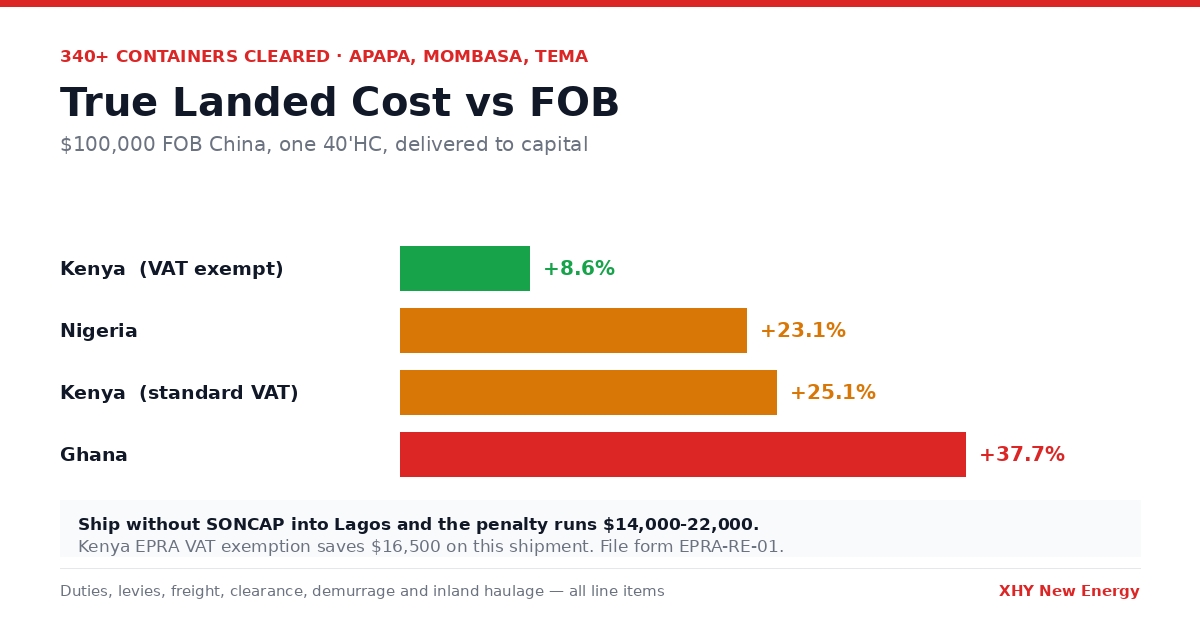
We cleared 340+ containers through Lagos Apapa, Mombasa, and Tema in 2024-2026. The tariff schedule says one thing; what you actually pay includes eight line items most suppliers never mention. Here's the real landed cost breakdown.
Customers ask me for FOB pricing. I tell them FOB means almost nothing — what matters is landed cost, and the gap between the two runs 18-34% depending on country and who handles your clearance.
We've cleared 340+ containers through Lagos Apapa, Mombasa, and Tema in 2024-2026. Here's every line item you'll pay and what each one actually costs.
Nigeria: Lagos Apapa Port
Official tariff schedule (2026):
- Import duty on solar modules: 5% (HS code 8541.40)
- VAT: 7.5%
- Combined effective: 12.9%
What you actually pay on a $100,000 FOB China shipment:
| Line item | Calculation | Amount |
|---|---|---|
| FOB value (modules only) | - | $100,000 |
| Ocean freight (Shanghai → Lagos, 40'HC) | Market rate Q3 2026 | $2,900 |
| CIF value | FOB + freight + insurance | $103,400 |
| Import duty 5% | On CIF | $5,170 |
| VAT 7.5% | On (CIF + duty) | $8,143 |
| ETLS fee (Nigeria Trade Portal) | Per container | $180 |
| Terminal handling charge (THC) | Per container | $420 |
| Inspection fee (SON / SONCAP) | 0.45% of CIF | $465 |
| Customs broker | Per container | $380-650 |
| Demurrage (if 2 days late) | $125/day × 2 | $250 |
| Port storage (days 4-6) | $18/day × 3 | $54 |
| Truck to site (Apapa → Kano, 1,050 km) | Per container | $1,600-2,100 |
| Total landed cost, Kano | $122,612-123,432 | |
| FOB → landed markup | 22.6-23.4% |
And that's assuming clearance takes four days and nothing goes wrong.
What Goes Wrong in Nigeria
SONCAP (Standards Organisation of Nigeria Conformity Assessment Programme): Solar modules need a Product Certificate (PC). First-time importers need to register the product ($850-1,200 depending on agent), then each shipment needs a SONCAP Certificate issued pre-shipment by an inspection agency (SGS, Intertek, Bureau Veritas — cost $680-950 per container).
If you ship without SONCAP, Customs impounds the container and you pay a penalty assessment (10-25% of CIF) plus demurrage while you sort it. We've seen $14,000-22,000 in extra costs on a single container from this mistake.
Getting a Nigeria PC takes 6-9 weeks if you're doing it yourself, 3-4 weeks through an experienced agent. Do not assume you can ship immediately after signing a module supply contract.
Apapa port demurrage is brutal: free days are typically 3-4, then $125/day that escalates to $180/day after day 7. The longest clearance delay we had in 2025 was 11 days (bank holiday, then a Customs officer rotation, then a weekend). Demurrage alone was $1,550.
Advice: use a customs broker who has a dedicated Customs relationship and can prioritize your container. The $380 broker we tried once took nine days. The $620 broker we use now averages 3.2 days. The $240 you save costs you $1,000+ in demurrage.
Kenya: Mombasa Port
Official tariff schedule (2026, EAC Common External Tariff):
- Import duty on solar modules: 0% (EAC renewable energy exemption under HS 8541.43)
- VAT: 16% (but exempt for specific project types — see below)
- Railway Development Levy (RDL): 1.5% on CIF
- Import Declaration Fee (IDF): 2.5% on CIF (capped at KES 2M for one importer, so usually 2.5%)
What you actually pay on a $100,000 FOB shipment:
| Line item | Amount |
|---|---|
| FOB value | $100,000 |
| Ocean freight (Shanghai → Mombasa, 40'HC) | $2,600 |
| CIF value | $103,100 |
| Import duty | $0 (exempt) |
| VAT 16% | $16,496 (see exemption below) |
| RDL 1.5% | $1,547 |
| IDF 2.5% | $2,578 |
| Container Freight Station (CFS) charges | $280 |
| Kenya Ports Authority handling | $190 |
| Customs broker | $420-680 |
| SGR (Standard Gauge Railway) to Nairobi | $950 |
| Truck final mile (Nairobi ICD → site) | $280-650 |
| Total landed cost, Nairobi area | $124,421-125,071 |
| Without VAT exemption | (if you qualify) |
| Total with VAT exemption | $107,925-108,575 |
| FOB → landed markup | 7.9-8.6% (exempt) or 24.4-25.1% (standard) |
Kenya VAT Exemption for Solar Projects
If your project qualifies as a "solar energy equipment installation" and you have a valid PIN and project approval from the Energy and Petroleum Regulatory Authority (EPRA), VAT on imported modules is zero-rated.
Qualification requirements:
- System size >20 kW OR grid-connected OR certified installer
- EPRA notification filed before import (form EPRA-RE-01, free, takes 2-3 weeks)
- Installation within 12 months of import
This exemption saves $16,500 on a $100k FOB shipment. It is absolutely worth doing the paperwork.
For smaller systems (<20 kW) or retail stock imports, you pay the full 16% VAT but can reclaim it if you're VAT-registered, which most commercial installers are.
Mombasa Clearance Speed
Mombasa port is significantly faster than Lagos on average. Our 2024-2026 clearance times:
- Median: 2.8 days
- 90th percentile: 4.5 days
- Longest: 8 days (due to a China-origin verification request on one shipment, now resolved by having the manufacturer pre-register)
Free storage at CFS is typically 4 days, then KES 1,500/day (~$11.50), so demurrage risk is lower than Nigeria.
The real cost variable in Kenya is inland transport. SGR to Nairobi is efficient and fixed-price ($950). Road haulage to upcountry sites varies wildly:
- Nairobi → Eldoret (310 km): $850-1,100
- Nairobi → Kisumu (350 km): $900-1,150
- Mombasa → Dar es Salaam (direct, bypassing Nairobi): $1,400-1,850
If your site is in western Kenya, shipping via Mombasa and then trucking 600+ km can cost more than shipping to Dar es Salaam (if you have Tanzania Customs clearance capability) and entering Kenya by road.
Ghana: Tema Port
Official tariff schedule (2026, ECOWAS CET):
- Import duty: 5% (HS 8541.43.00)
- NHIL (National Health Insurance Levy): 2.5%
- GETFund Levy: 2.5%
- VAT: 12.5% on (CIF + duties + levies)
- COVID-19 Health Recovery Levy: 1% (still active as of Q3 2026)
Effective total: roughly 24.7% on CIF.
What you actually pay on a $100,000 FOB shipment:
| Line item | Amount |
|---|---|
| FOB value | $100,000 |
| Ocean freight (Shanghai → Tema, 40'HC) | $3,100 |
| CIF value | $103,600 |
| Import duty 5% | $5,180 |
| NHIL 2.5% | $2,590 |
| GETFund 2.5% | $2,590 |
| Subtotal for VAT base | $113,960 |
| VAT 12.5% | $14,245 |
| COVID levy 1% | $1,036 |
| Destination inspection fee (GCNET/ICUMS) | $145 |
| Tema Port charges | $385 |
| Customs clearing agent | $450-700 |
| Examination fee (if randomly selected, ~30% chance) | $0 or $280 |
| Truck to Accra | $180-280 |
| Total landed cost, Accra | $137,406-138,036 |
| FOB → landed markup | 37.4-38.0% |
Ghana is the most expensive of the three countries we're comparing, largely due to the layered levy structure.
Ghana Renewable Energy Exemptions
There is a duty exemption available under the Renewable Energy Act 2011 (Act 832), but it requires:
- Project registered with the Energy Commission
- Letter of No Objection from the Ministry of Energy
- Environmental permit from the EPA
- System must be grid-connected OR >100 kW standalone
Processing time: 8-14 weeks, and most commercial customers tell us they can't wait that long, so they pay the full tariff and absorb it. For utility-scale projects (5 MW+) the exemption is worth pursuing; for 100-500 kW commercial, the admin burden usually exceeds the savings.
We've done the exemption twice. Both times it took 11+ weeks and required a local attorney to navigate the Energy Commission. Budget $3,500-6,000 in professional fees.
Tema Port Clearance
Tema introduced the ICUMS (Integrated Customs Management System) in 2022, and it's significantly improved processing times. Our recent experience:
- Median clearance: 3.5 days
- 90th percentile: 6 days
- Free days: 5, then GHS 150/day demurrage (~$11/day at Q3 2026 FX)
Tema's demurrage is gentler than Lagos, and Customs officers are less prone to arbitrary holds. The trade-off is that the levy stack is heavier.
Container Loading Optimization
The number of modules you fit in a 40'HC directly affects your per-watt landed cost. Small differences in packing efficiency swing the total by 2-4%.
JinKO 650W (JKM625-650N), 2172×1303×30mm:
- Per pallet: 36 modules
- Per 40'HC: 684 modules (19 pallets) = 444.6 kW
- Some shippers fit 720 modules (20 pallets) = 468 kW, but only if the container floor and doors are in good condition and you're willing to hand-stack the last row (adds risk of shipping damage).
JinKO 620W (JKM605-630N), same dimensions:
- 684 modules = 438.96 kW (at 620W bin)
- 708 modules (tight pack) = 438.96 kW
LONGi 650W (LR8-66HVD 640-670M), 2172×1303×35mm (slightly thicker):
- 684 modules = 444.6 kW
- Because of the extra 5mm thickness, 720-module tight-packing is riskier — we've seen two shipments with edge damage when the factory tried this.
JinKO 720W (JKM710-735N), 2278×1303×30mm:
- 624 modules (standard) = 449.28 kW
- 648 modules (tight pack) = 466.56 kW
Landed cost per watt swings on container efficiency:
- 684 modules at $103,400 CIF + $22,612 inland (Nigeria example) = $126,012 ÷ 444.6 kW = $0.283/W
- 720 modules (468 kW tight pack, same CIF+inland) = $126,012 ÷ 468 kW = $0.269/W
That's a 5% swing in landed cost from packing alone. Always ask your supplier what their confirmed container loading is, not the theoretical maximum.
Currency and Payment Terms
Most Chinese module suppliers quote FOB in USD and require either:
- 30% deposit + 70% before shipment (TT), or
- Irrevocable Letter of Credit (LC) at sight
LC costs in African banks (2026 rates):
- Nigeria: 1.2-1.8% of LC value + $450-850 issuance fee
- Kenya: 0.8-1.4% + $380-650
- Ghana: 1.5-2.2% + $500-900
On a $100k module order, Nigerian LC costs run $1,650-2,650. That's another hidden cost that doesn't appear in anyone's initial quote.
TT (wire transfer) is cheaper (flat $25-45 fee), but many suppliers won't ship on TT terms for first-time buyers, and it offers you zero recourse if modules arrive defective.
Our recommendation for orders >$75k: use LC for the first shipment, switch to TT once trust is established. The LC cost is worth it as insurance.
FX Risk
If you're signing a contract in USD but paying local staff and EPC contractors in Naira, Shilling, or Cedi, currency depreciation is a real risk between contract signature and project completion.
Naira depreciation, Jan 2024 - Aug 2026: NGN 950/USD → NGN 1,580/USD = 66% loss Kenya Shilling: KES 143/USD → KES 130/USD = 9% gain (rare) Ghana Cedi: GHS 12.1/USD → GHS 13.8/USD = 14% loss
If your PPA or sales contract is in local currency but your module purchase is in USD, either:
- Lock FX forward (costs 1.8-4.5% p.a. depending on currency)
- Index the PPA to USD/CNY (if the off-taker agrees, which most don't)
- Build a 15-20% FX buffer into your financial model
We've seen three Nigerian projects go insolvent between 2024-2026 because they modelled at NGN 950/USD and executed at NGN 1,480/USD. The module cost in Naira terms rose 56%, and the equity ran out before commissioning.
Shipping Time and Inventory Risk
Typical lead times (factory gate China → site delivery):
- Module production: 4-7 weeks after deposit (depending on factory backlog)
- Inland China transport + export clearance: 5-8 days
- Ocean transit Shanghai → Lagos: 32-38 days
- Ocean transit Shanghai → Mombasa: 28-34 days
- Ocean transit Shanghai → Tema: 35-42 days
- Port clearance + inland transport: 4-9 days
Total: 11-15 weeks from deposit to modules on site.
If you're on a PPA with liquidated damages for missing COD, add a four-week buffer to whatever the supplier quotes. We've had shipments delayed by:
- Port congestion (Tema, June 2025, eight extra days)
- Typhoon (Shanghai port closure, July 2026, six days)
- Customs hold for random physical inspection (Lagos, multiple times, 2-5 days each)
Summary Table: True Landed Cost
$100,000 FOB, one 40'HC, to the capital city of each country:
| Country | Duties + levies | Freight + clearance | Total landed | Markup over FOB |
|---|---|---|---|---|
| Nigeria | $13,313 | $9,299-9,819 | $122,612-123,132 | 22.6-23.1% |
| Kenya (with VAT exemption) | $4,125 | $3,800-4,450 | $107,925-108,575 | 7.9-8.6% |
| Kenya (standard) | $20,621 | $3,800-4,450 | $124,421-125,071 | 24.4-25.1% |
| Ghana | $25,841 | $11,565-11,845 | $137,406-137,686 | 37.4-37.7% |
Kenya with exemption is by far the cheapest, assuming you have the EPRA approval. Without it, Nigeria and Kenya are roughly equivalent. Ghana is 12-15 percentage points more expensive than the others due to its levy stack.
Practical Checklist Before You Order
- HS code confirmation — verify with your customs broker that solar modules are classified 8541.40 (Nigeria) or 8541.43 (Kenya/Ghana). One digit wrong costs you.
- SONCAP / PVOC registration — Nigeria needs SONCAP PC, Kenya needs nothing for <$5k value or PVOC for higher, Ghana needs ECOWAS compliance if asked.
- VAT exemption paperwork — if you're in Kenya and qualify, file EPRA-RE-01 six weeks before shipment.
- LC vs TT — decide payment terms and get bank quotes for LC cost.
- Container loading — confirm with supplier how many modules actually fit (not theoretical max).
- Incoterms — FOB is standard, but some suppliers offer CIF or DDP. DDP (delivered duty paid) sounds convenient but usually costs 8-12% more than doing it yourself.
- FX hedge — if your contract is in local currency, consider forward cover for USD exposure.
- Insurance — ocean freight includes basic carrier liability (~$500/container), but all-risk cargo insurance costs 0.3-0.6% of CIF and is worth it for high-value shipments.
Need a landed cost quote for your specific port and project size? I can connect you with our clearing agents in Lagos, Mombasa, and Tema and give you a line-item breakdown before you commit. Jack Chen | ivy@longijinko.com | WhatsApp +86 189 0619 0578 JinKO, LONGi, JA Solar, Trina modules — cleared through 12 African ports since 2020.
Have Questions About This Article?
Our technical team is here to help you choose the right solar solution for your project.