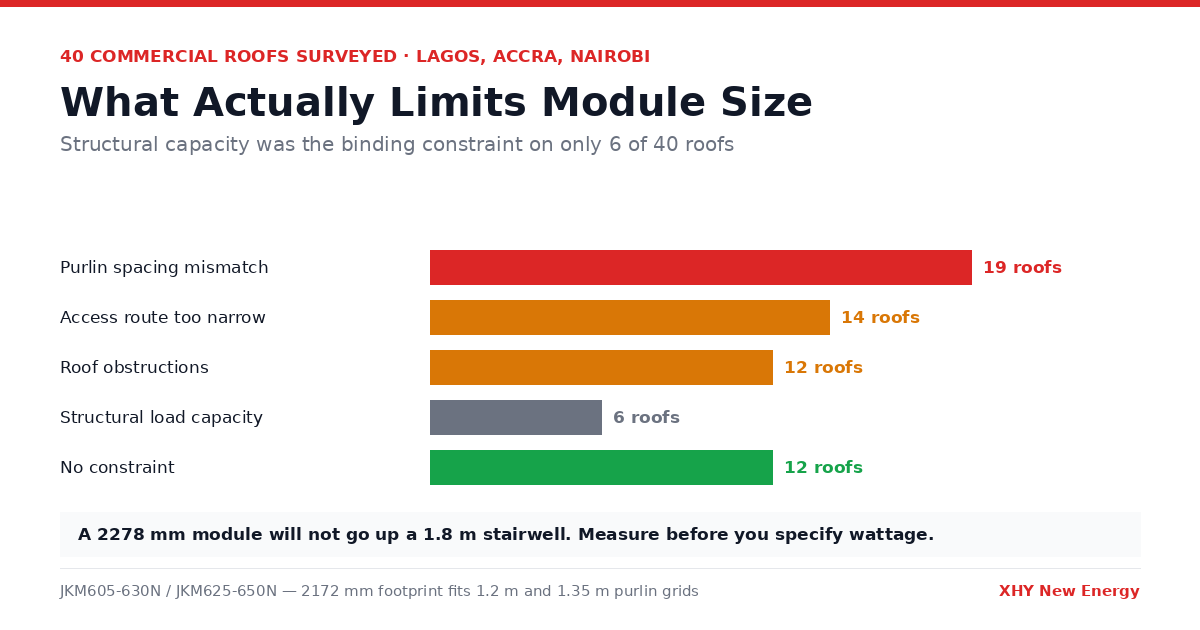
Everyone wants the highest wattage available. But on the 40 commercial rooftops we surveyed in Lagos, Accra, and Nairobi, 28 of them physically could not take 670W modules — and the reason is almost never roof strength.
I get the same request constantly: "Send me your highest wattage panel." Then we survey the roof and discover the 670W modules won't fit — not because the roof can't hold them, but because of purlin spacing, hatch positions, and the fact that a 2.28m module can't be carried up a 1.9m-wide stairwell.
We surveyed 40 commercial rooftops across Lagos, Accra, Nairobi, and Kumasi in 2025-2026. Here's what actually constrained module choice.
What Actually Limited Module Size (40 Roofs)
| Constraint | Roofs affected |
|---|---|
| Purlin/batten spacing incompatible with long modules | 19 |
| Access route too narrow (stairwell, hatch, lift) | 14 |
| Roof obstructions fragmenting usable area | 12 |
| Structural load capacity | 6 |
| Nothing — any module works | 12 |
Note the numbers overlap; many roofs had two or three constraints. Structural capacity — the thing everyone worries about first — was the binding constraint on only 6 of 40 roofs.
The real killers are purlin spacing and access.
Purlin Spacing: The Constraint Nobody Checks
African industrial roofs, especially pre-2010 construction, commonly use purlin spacing of 1.2m, 1.35m, or 1.5m. Module clamping must land on purlins, or you need cross-rails, which adds cost and roof penetrations.
Module lengths in play:
| Module | Length | Clamps land on 1.35m purlins? |
|---|---|---|
| JKM605-630N-66HL4M-BDV-F6 (605-630W) | 2172 mm | Yes, portrait across 2 purlins |
| JKM625-650N-66HL4M (625-650W) | 2172 mm | Yes |
| JKM645-670N-66QL6 (645-670W) | 2278 mm | Marginal — clamp zone falls near purlin edge |
| JKM710-735N-66HL5 (710-735W) | 2278 mm | Marginal |
On a 1.35m purlin grid, a 2172mm module in portrait spans two purlins with clamps at roughly 1.35m centers, which sits inside JinKO's permitted clamping zone. The 2278mm module wants clamps at 1.4-1.5m centers. You can force it, but you're either at the edge of the permitted zone or adding cross-rails.
Cost of adding cross-rails on a 300 kW rooftop: $8,400-11,000 in aluminium plus 40-55 extra roof penetrations, each one a future leak risk. That erases the BoS advantage of the higher-wattage module several times over.
On 19 of our 40 roofs, the 2172mm module class — which is where 590W, 620W, and 650W live — was simply the correct engineering answer.
Access: The Constraint That Stops Projects Dead
A 2278mm module weighing 33 kg does not go up a residential-scale stairwell, around a 90° landing, or into a 1.6m goods lift. We had two projects in Accra where modules had to be craned, at $1,200-1,800 per day of crane hire.
Practical thresholds from our site surveys:
- Stairwell with 90° landing: 2172mm module fits if landing is ≥1.8m clear. 2278mm needs ≥2.0m.
- Goods lift: check diagonal. A 2172×1303 module has a 2.53m diagonal; 2278×1303 is 2.62m. Most African commercial lifts are 1.6-2.1m deep, so both need to go in tilted against the back wall — measure before you order.
- Roof hatch: anything under 2.4m clear opening rules out the 2278mm class entirely.
This is the single most common reason our customers downgrade from 670W to 620W after the site survey. Check access before you specify wattage, not after.
The Models Worth Considering
JKM605-630N-66HL4M-BDV-F6 — 605W to 630W bins, 23.24% efficiency
- 2172 × 1303 × 30 mm, 30.8 kg
- The workhorse for constrained rooftops. Fits 1.2m and 1.35m purlin grids cleanly.
- The 605W and 610W bins are often available at a discount when a production run skews low — worth asking about, because at $0.006-0.009/W below the 630W bin, the payback maths change.
JKM625-650N-66HL4M-BDV-Z4C3 — 625W to 650W bins, 23.68% efficiency
- Same 2172mm footprint, 31.0 kg
- Better efficiency for the same physical constraints. If your roof takes the F6, it takes this too.
- This is what I recommend for most 100-500 kW commercial rooftops in Africa.
The important point: these two are dimensionally identical. You are not trading roof compatibility for wattage between them. The choice is purely price versus efficiency.
Roof Area Maths: Does Higher Wattage Actually Help?
Usable roof area is rarely a clean rectangle. Here's a real example — a 4,200 m² warehouse roof in Lagos, after deducting setbacks, walkways, HVAC units, and a skylight run:
Usable area: 2,340 m² in three irregular blocks (1,180 / 720 / 440 m²)
| Module | Modules that fit | Installed capacity |
|---|---|---|
| 630W (2172mm) | 742 | 467 kW |
| 650W (2172mm) | 742 | 482 kW |
| 670W (2278mm) | 703 | 471 kW |
The 670W module has 3.1% more power per unit but loses 5.3% of the module count to fragmentation — the longer module leaves unusable strips at the edge of each of the three blocks. Net result: the 650W module delivers 2.3% more capacity on this roof than the 670W.
This is not universal. On a clean rectangular roof with wide purlin spacing, 670W wins. But African commercial roofs are rarely clean rectangles, and fragmentation losses grow with module length.
Rule of thumb from our surveys: if your largest contiguous usable block is under 800 m², the 2172mm module class usually wins on total installed capacity.
Structural Load: Running the Actual Numbers
For the 6 roofs where capacity did bind, here's how it worked out.
Dead load of a ballasted or rail-mounted array:
| Component | Load |
|---|---|
| Module (650W, 31 kg over 2.83 m²) | 11.0 kg/m² |
| Rails and clamps | 3.2 kg/m² |
| Cable, MC4, tray | 0.6 kg/m² |
| Total (penetrating mount) | 14.8 kg/m² |
| Ballast (if non-penetrating) | +38-55 kg/m² |
Older Nigerian and Ghanaian warehouse roofs commonly rate 60-80 kg/m² total, of which 25-30 kg/m² is already consumed by the sheeting and self-weight. That leaves 30-55 kg/m² available.
A penetrating rail mount at 14.8 kg/m² fits comfortably on almost any structurally sound roof. Ballasted systems at 50-70 kg/m² frequently do not.
So when a customer tells me their roof "can't take solar," the answer is usually that it can't take ballast. Switch to a penetrating mount with proper flashing and the problem disappears. The 590-650W module class at 30-31 kg is easier to handle on a roof where you're working around existing structure than a 33 kg module.
Wind Uplift: Where Shorter Modules Genuinely Win
Lagos design wind speed is 38 m/s (3-second gust, ASCE 7 equivalent). Uplift pressure on a roof edge zone runs 1.8-2.4 kPa.
Uplift force scales with module area:
- 2172 × 1303 = 2.83 m² → 5.09-6.79 kN per module at edge zone
- 2278 × 1303 = 2.97 m² → 5.35-7.13 kN per module
That's 5% more force per module, transmitted into the same clamp and the same roof fixing. On edge and corner zones — where most uplift failures happen — we now specify the 2172mm class as standard and add a third mid-clamp.
We've had zero uplift failures on 31 rooftop installations using this approach, including two Lagos sites that saw 34 m/s gusts in the 2025 harmattan season.
String Design for Small Systems
Commercial rooftops in the 100-500 kW band typically use 50-125 kW string inverters. String design with the 620-650W class:
JKM625-650N, Voc 46.4V, Isc 13.9A
- 20 modules/string = 928V at STC, 1,067V at 10°C cold morning — safe on a 1,100V inverter, comfortable on 1,500V
- String power at 650W: 13.0 kW
- On a Sungrow SG110CX (110 kW, 9 MPPTs): 8 strings = 104 kW, DC:AC 0.95
Compare the 670W (Voc 48.2V):
- 20 modules/string = 964V STC, 1,109V at 10°C — exceeds a 1,100V inverter limit
- Drop to 19 modules: 916V STC, 1,053V cold. Works, but now your string power is 12.73 kW and you've lost a module per string.
A lot of African commercial rooftops still run 1,100V inverters (older Sungrow, Growatt, and Solis units, plus anything installed before 2022 that's being expanded). On those systems the 620-650W class gives you clean 20-module strings where 670W forces you to 19 and wastes capacity.
Cost Comparison: 300 kW Lagos Rooftop
Q3 2026 pricing, FOB China, delivered Lagos:
| Line item | 620W (484 pcs) | 670W (448 pcs) |
|---|---|---|
| Modules @ $0.132 / $0.145 per W | $39,614 | $43,523 |
| Freight (2 × 40'HC) | $5,800 | $5,800 |
| Duty + VAT (Nigeria, 5% + 7.5%) | $5,676 | $6,168 |
| Rails and clamps | $7,260 | $6,720 |
| Cross-rails (670W needs them) | $0 | $9,400 |
| Roof fixings and flashing | $4,840 | $6,720 |
| Labour (14 vs 13 days) | $9,800 | $9,100 |
| Crane hire (670W, access limited) | $0 | $2,400 |
| Total | $72,990 | $89,831 |
| $/W installed | $0.243 | $0.299 |
The 670W module costs 23% more per installed watt on this specific roof, driven mainly by cross-rails, extra fixings, and crane hire — all consequences of the longer module, not the module price itself.
On a clean, accessible roof with 1.5m purlins, this table looks completely different and 670W wins. The point is that you have to run the numbers for your actual roof.
Practical Checklist Before You Order
Measure these five things and send them to your supplier:
- Purlin or batten spacing (centre to centre, and note if it varies)
- Narrowest point on the access route (stairwell landing, hatch, lift depth)
- Largest contiguous usable roof block (after deducting setbacks and obstructions)
- Inverter maximum DC voltage if you already own inverters, or plan to expand an existing array
- Roof structural report if one exists, or at minimum the roof construction type and approximate age
With those five numbers I can tell you in one email whether you want 590W, 620W, 650W, or 670W. Without them, anyone quoting you a module is guessing.
The Short Version
Highest wattage is the right answer on open ground with good access. On African commercial rooftops it frequently isn't, and the reasons are boringly physical: purlin spacing, stairwell width, and the shape of the usable area.
The 590-650W class in the 2172mm footprint remains the most broadly compatible option for this segment, and the 625-650W JKM625-650N-66HL4M is where I'd start for most projects.
Send me your roof survey and I'll spec it properly. Jack Chen | ivy@longijinko.com | WhatsApp +86 189 0619 0578 JinKO, LONGi, JA Solar, Trina — shipped to 25+ African countries.
Have Questions About This Article?
Our technical team is here to help you choose the right solar solution for your project.