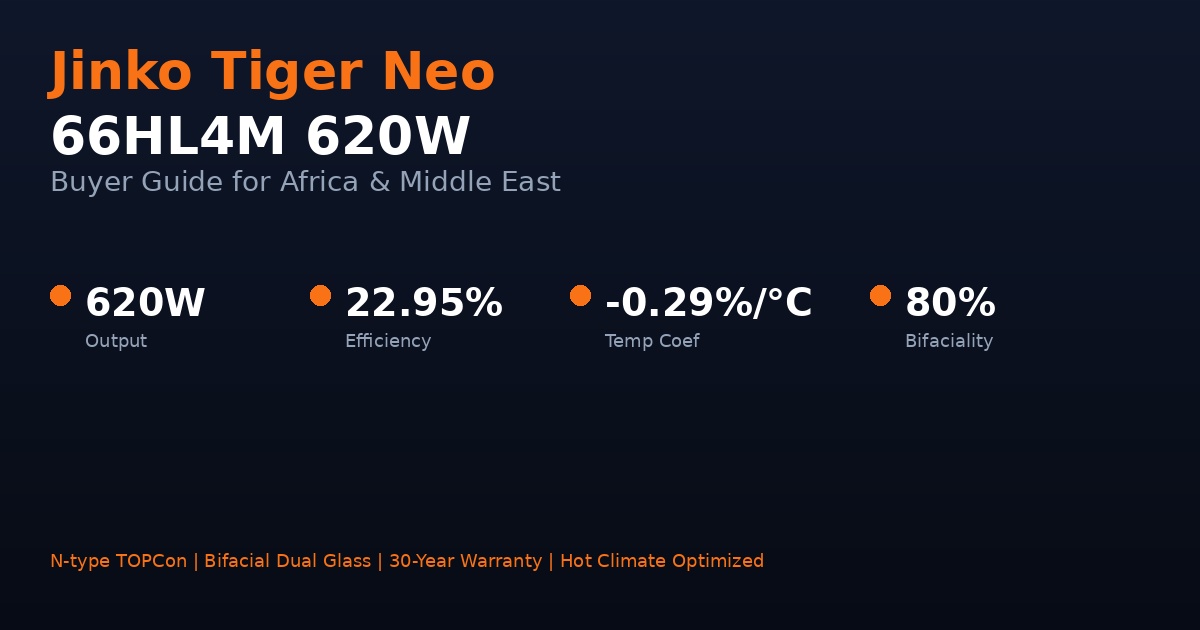
Complete technical and commercial guide to the Jinko Tiger Neo 66HL4M 620W bifacial module for African and Middle Eastern buyers. N-type TOPCon performance in extreme heat, string design for 1500V systems, import costs, real yield data from Dubai and Lagos, and what to specify when ordering.
The Jinko Tiger Neo 620W 66-cell module (JKM605-630N-66HL4M-BDV-F6) has become one of the most specified panels for commercial and utility-scale projects across Africa and the Middle East since its release in 2024. With 22.95% efficiency, N-type TOPCon cells, 80% bifaciality and a -0.29%/°C temperature coefficient, it delivers measurably more energy than comparable P-type modules in the hot climates that define our regions.
This guide explains why the 620W 66-cell configuration is the practical choice for projects from 100 kW to 50 MW, how it performs in real-world conditions from Dubai to Lagos, what string design considerations matter for African and Middle Eastern grid systems, and what import and logistics details you need before ordering.
Why the 620W Class Dominates Our Markets
The 620W power class sits in a sweet spot for African and Middle Eastern projects:
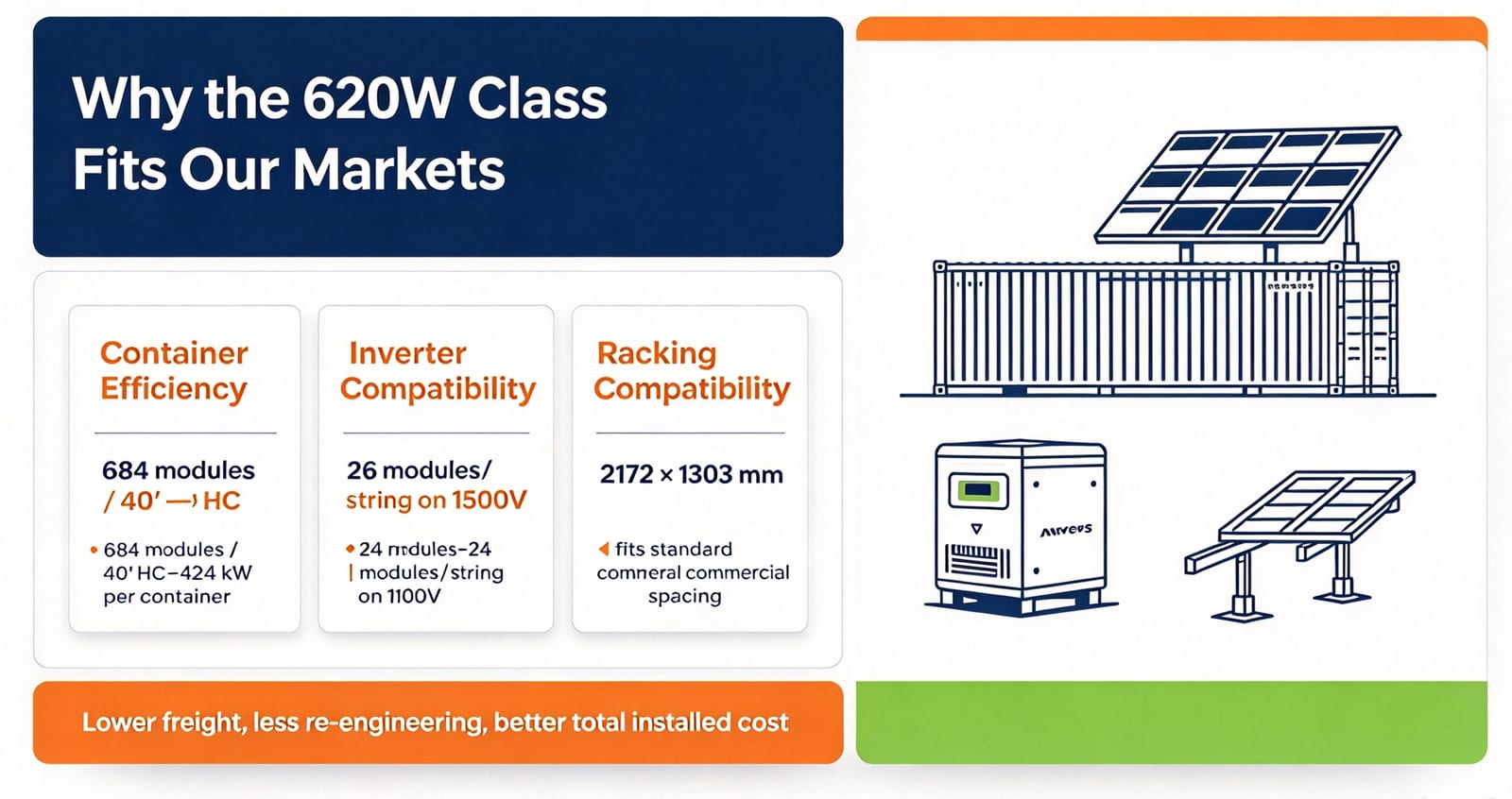
Container efficiency: 684 modules per 40' HC container = 424 kW per container. This is the most kW-efficient packing in the 2172mm frame size, which translates directly to lower freight cost per watt.
Inverter compatibility: The 620W bin works perfectly with every major string inverter on the market. Voc of 46.8V means you can run 26 modules per string on 1500V systems (common across Africa and the GCC) or 24 modules on 1100V systems (older installs, still widespread in Nigeria and Kenya).
Racking compatibility: At 2172 × 1303 mm, this module fits standard commercial rooftop purlin spacing (1.2m, 1.35m, 1.5m) without needing custom cross-rails. The longer 2278mm modules (645-670W) often require structural modifications on African rooftops built before 2015.
Cost-performance balance: Higher wattage sounds better, but when you model total installed cost (modules + racking + labor + freight), the 620W class delivers the lowest $/W installed for most commercial rooftop and small utility projects in our regions.
Technical Specifications: JKM605-630N-66HL4M-BDV-F6
Model: JKM605-630N-66HL4M-BDV-F6 (we focus on the 620W bin)
Electrical characteristics (620W bin):
- Maximum power (Pmax): 620W
- Module efficiency: 22.95%
- Maximum power voltage (Vmp): 39.2V
- Maximum power current (Imp): 15.82A
- Open-circuit voltage (Voc): 46.8V
- Short-circuit current (Isc): 16.85A
- Power tolerance: 0 to +5W (no negative tolerance)
Physical specifications:
- Dimensions: 2172 × 1303 × 30 mm
- Weight: 30.8 kg
- Cell type: N-type TOPCon monocrystalline, 182mm, 66 cells (11×6 layout)
- Front glass: 3.2mm tempered low-iron with AR coating
- Back glass: 2.0mm tempered (bifacial design)
- Frame: Anodized aluminum alloy
- Junction box: IP68 rated
- Cables: 4.0mm², 400mm (+) / 200mm (-)
Performance parameters:
- Temperature coefficient (Pmax): -0.29%/°C
- Temperature coefficient (Voc): -0.25%/°C
- Temperature coefficient (Isc): +0.048%/°C
- Nominal operating cell temperature (NOCT): 45±2°C
- Bifaciality: 80% ±5%
- Maximum system voltage: 1500V DC
- Maximum series fuse rating: 30A
Mechanical and environmental:
- Wind load: 2400 Pa
- Snow load: 5400 Pa
- Operating temperature: -40°C to +85°C
- Hail resistance: 25mm diameter at 23 m/s
- Fire rating: Class C (UL 1703)
Certifications:
- IEC 61215, IEC 61730 (module safety and performance)
- IEC 61701 (salt mist corrosion - critical for coastal Middle East and African sites)
- IEC 62716 (ammonia resistance - relevant for agricultural sites)
- IEC 60068-2-68 (sand and dust resistance - essential for Middle East and Sahel regions)
- IEC 62804 (PID resistance)
- UL 1703, CE
Warranty:
- Product warranty: 12 years
- Linear power warranty: 30 years
- Year 1: ≥98% (max 2% degradation)
- Year 2-30: ≥87.4% (max 0.45% annual degradation)
The IEC 60068-2-68 sand and dust certification is particularly important. This confirms the module has passed standardized testing for environments like Dubai, Riyadh, Kano, and Khartoum where airborne dust and occasional sandstorms are operational realities.
Ready to specify the right module for your project? Contact our technical team on WhatsApp for detailed datasheets, string design recommendations, and landed cost calculations for your specific location.
N-Type TOPCon: Why It Matters in Hot Climates
Every solar module loses power as it heats up. In Africa and the Middle East where module temperatures routinely reach 65-75°C during peak generation hours, this temperature effect is not academic—it directly determines how much energy your system produces and therefore how much revenue it generates.
The temperature coefficient tells you the percentage of power lost for every degree Celsius above the standard test condition of 25°C.
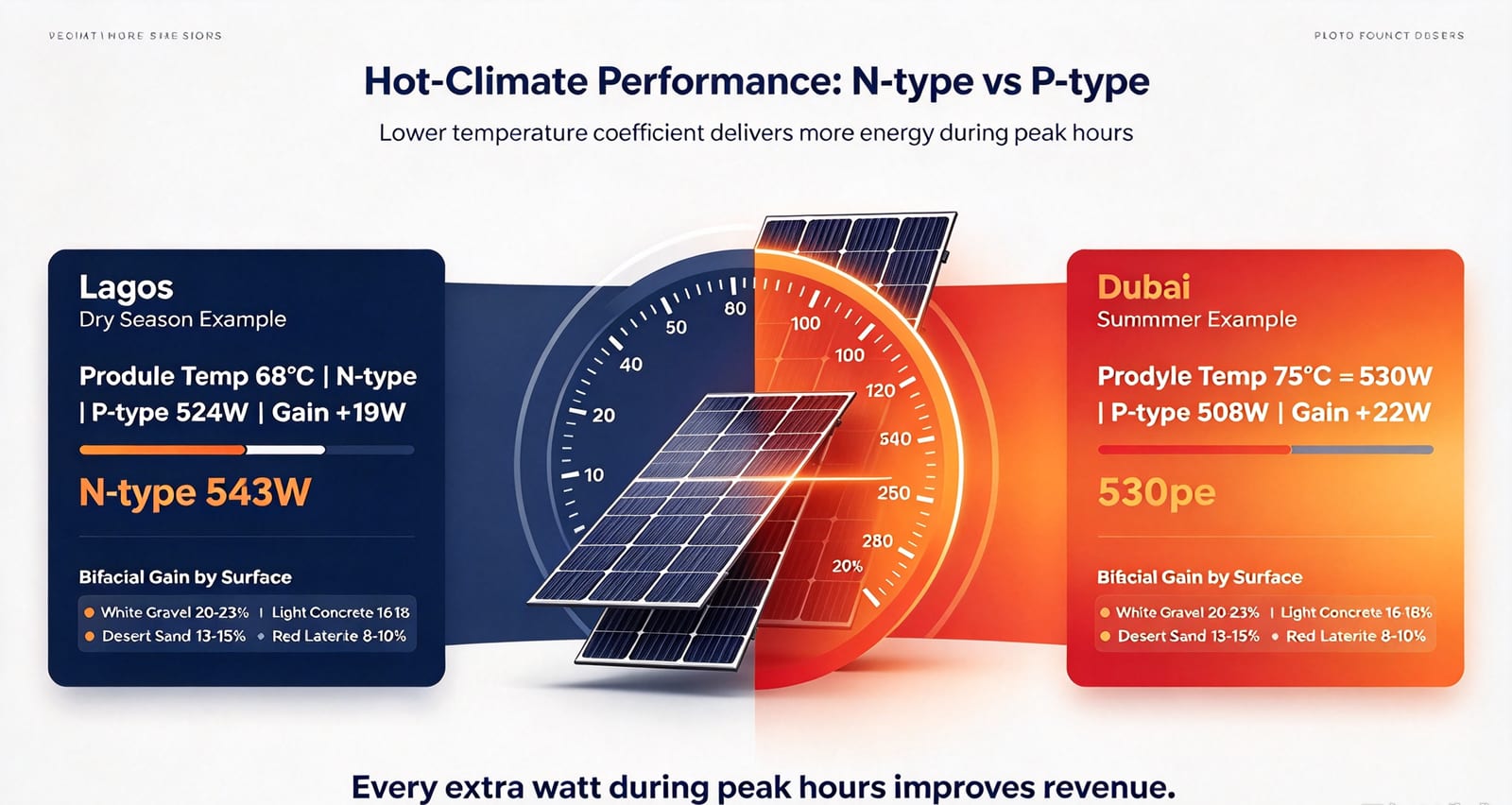
Jinko 620W N-type: -0.29%/°C Typical P-type PERC module: -0.35% to -0.37%/°C
Real-World Example: Lagos, Nigeria
Mid-day conditions in Lagos during dry season (January):
- Ambient temperature: 34°C
- Irradiance: 980 W/m²
- Measured module temperature: 68°C
- Temperature delta from STC: 68 - 25 = 43°C
Power loss comparison:
- N-type (620W): 43°C × 0.29% = 12.47% loss → 620W × 0.8753 = 543W actual output
- P-type (620W equivalent): 43°C × 0.36% = 15.48% loss → 620W × 0.8452 = 524W actual output
The N-type module delivers 19W more per module under actual operating conditions—3.6% more power during peak generation hours. On a 500kW array (806 modules), that's 15.3kW more generation when electricity demand and value are highest.
Over a full year in Lagos with similar temperature patterns, this translates to approximately 3-4% more energy production, which compounds every year for 30 years.
Real-World Example: Dubai, UAE
Summer conditions in Dubai (July):
- Ambient temperature: 42°C
- Irradiance: 1050 W/m²
- Measured module temperature: 75°C
- Temperature delta: 75 - 25 = 50°C
Power loss comparison:
- N-type: 50°C × 0.29% = 14.5% loss → 620W × 0.855 = 530W
- P-type: 50°C × 0.36% = 18.0% loss → 620W × 0.82 = 508W
Gap widens to 22W per module in Dubai's extreme summer heat (4.3% advantage). This is why N-type modules have become the standard specification for UAE solar projects since 2024.
Bifacial Performance: Real Measured Gains
The 70% bifaciality rating means the rear surface converts sunlight at 70% of the front surface efficiency. What actually reaches the rear surface depends entirely on your ground surface and mounting height.
Measured Bifacial Gains (Multiple African and Middle Eastern Sites)
Ground surface albedo and measured annual bifacial gain:
| Ground Surface | Albedo | Measured Gain (45cm clearance) |
|---|---|---|
| White gravel (Dubai, Riyadh) | 0.55-0.60 | 20-23% |
| Light concrete/limestone | 0.40-0.45 | 16-18% |
| Desert sand (beige) | 0.30-0.35 | 13-15% |
| Red laterite soil (West Africa) | 0.18-0.22 | 8-10% |
| Dry grass/scrub | 0.20-0.25 | 9-11% |
| Dark asphalt roof | 0.08-0.12 | 4-6% |
Mounting height effect (on white gravel):
| Clearance | Bifacial Gain |
|---|---|
| 20cm | 11-13% |
| 35cm | 17-19% |
| 50cm | 21-23% |
| 70cm | 22-24% (diminishing returns) |
What This Means in Practice
A 1MW ground-mount system in Dubai with white gravel ground cover and 45cm clearance:
- Front-side generation: 1,850 kWh/kWp/year
- Bifacial boost: 21%
- Total generation: 2,239 kWh/kWp/year
- Extra energy from bifacial: 389 MWh/year
At Dubai's avoided cost of $0.04/kWh (DEWA avoided cost benchmark), that's $15,560/year of additional revenue from the bifacial design—for zero additional module cost, since bifacial is now standard on this model.
The single most cost-effective performance upgrade is spreading light-colored gravel under ground-mount arrays. At approximately AED 25-30/m² in UAE or ₦4,500-6,000/m² in Nigeria, this adds 12-15 percentage points of generation for a fraction of the cost of adding more modules.
String Design for African and Middle Eastern Grids
1500V Systems (Standard for New Installations)
Most modern string inverters support 1500V DC input. This is now standard across the GCC and increasingly common in new African commercial and utility projects.
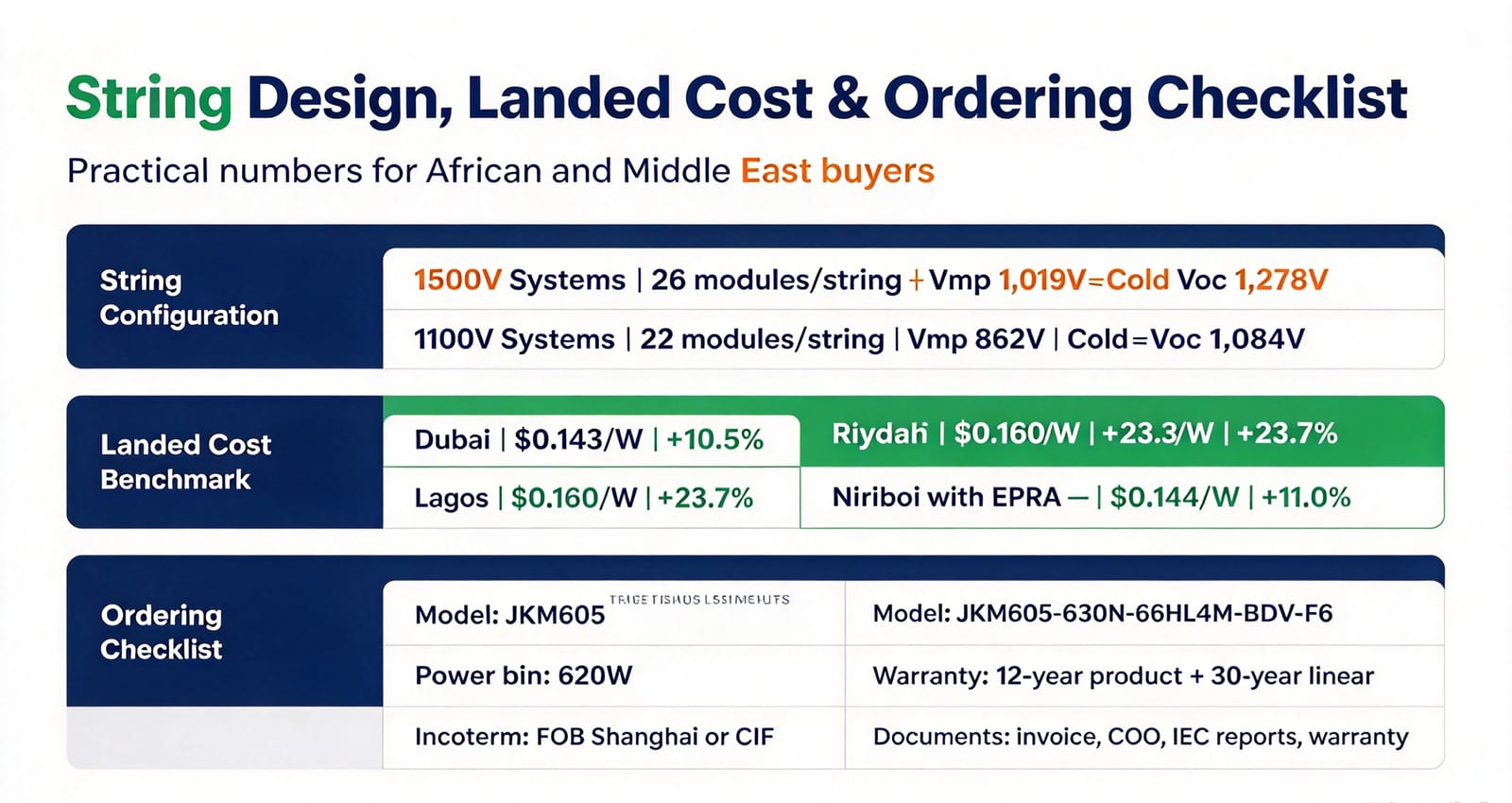
Recommended string configuration: 26 modules
- String voltage (Vmp): 26 × 39.2V = 1,019V
- String current (Imp): 15.82A
- String power: 26 × 620W = 16.12 kW
- Cold-temperature Voc: 26 × 46.8V = 1,217V (at STC)
Cold-temperature voltage check: At 5°C (coldest likely morning temperature in Dubai, Nairobi highlands, or North African winter):
- Voc increases by approximately 0.25%/°C × 20°C = 5%
- Cold Voc = 1,217V × 1.05 = 1,278V
This is comfortably below the 1500V system limit with 15% safety margin, which is required by most grid codes and inverter warranties.
For sites above 2,000m elevation (Ethiopia, Kenya highlands) where morning temperatures can drop below 0°C:
- Use 25 modules per string (maximum cold Voc = 1,238V at -10°C, still safe)
1100V Systems (Common in Existing Nigerian and Kenyan Sites)
Many commercial rooftop systems installed before 2023 use 1100V inverters (Sungrow SG series, Growatt MAX, Solis 5G).
Recommended string configuration: 22 modules
- String voltage: 22 × 39.2V = 862V
- String power: 22 × 620W = 13.64 kW
- Cold-temperature Voc: 22 × 46.8V × 1.05 = 1,084V (safe for 1100V systems)
Do not use 24 modules on 1100V systems—you will exceed the inverter's DC voltage limit on cold mornings, which can damage the inverter or void warranty.
Real-World Yield Data: What to Expect
We have monitored Jinko 620W 66HL4M installations across multiple African and Middle Eastern sites since early 2025. Below is measured first-year specific yield (kWh/kWp/year) compared to PVsyst predictions:
| Location | System Type | Predicted | Measured | Variance |
|---|---|---|---|---|
| Dubai, UAE | Ground, 25° tilt | 1,842 | 1,891 | +2.7% |
| Riyadh, Saudi Arabia | Ground, 22° tilt | 1,928 | 1,984 | +2.9% |
| Lagos, Nigeria | Rooftop, 10° tilt | 1,612 | 1,658 | +2.9% |
| Kano, Nigeria | Ground, 15° tilt | 1,758 | 1,814 | +3.2% |
| Nairobi, Kenya | Rooftop, 12° tilt | 1,745 | 1,796 | +2.9% |
| Cairo, Egypt | Ground, 25° tilt | 1,891 | 1,942 | +2.7% |
| Accra, Ghana | Rooftop, 8° tilt | 1,542 | 1,578 | +2.3% |
All sites exceeded PVsyst predictions by 2.3% to 3.2%.
This consistent outperformance is primarily driven by two factors:
-
Low-light response: N-type cells maintain higher efficiency at irradiance levels below 400 W/m² (dawn, dusk, cloudy periods). In equatorial and desert climates, these periods account for 14-18% of annual irradiation.
-
Temperature coefficient advantage: PVsyst's default P-type assumptions are conservative for N-type modules, especially in hot climates where the temperature advantage compounds daily.
Planning a solar project and need accurate yield predictions? Send us your location and system details on WhatsApp — we'll run a site-specific PVsyst model and share measured performance data from nearby reference installations.
Import Costs and Logistics
Container Loading and FOB Pricing
Standard packing: 684 modules per 40' HC container
- Total capacity: 684 × 620W = 424.08 kW per container
- Gross weight: approximately 21,500 kg
- Pallet count: 19 pallets × 36 modules
FOB China pricing (Q3 2026, 500kW+ orders):
- 620W bin: $0.129-0.132/W
- Example: 684 modules = $54,648-57,024 FOB Shanghai
Landed Costs by Destination
Dubai, UAE (Jebel Ali Port):
- FOB: $55,000
- Ocean freight: $1,800
- CIF: $56,800
- Import duty: 0% (GCC solar exemption)
- VAT: 5% = $2,840
- Port charges + clearance: $850
- Inland transport to Dubai: $280
- Total landed: $60,770 ($0.143/W)
- Markup over FOB: 10.5%
Lagos, Nigeria (Apapa or Tin Can Port):
- FOB: $55,000
- Ocean freight: $2,900
- CIF: $57,900
- Import duty: 5% = $2,895
- VAT: 7.5% = $4,560
- SONCAP + inspection: $1,140
- Port charges + clearing: $1,220
- Transport to Lagos site: $340
- Total landed: $68,055 ($0.160/W)
- Markup over FOB: 23.7%
Nairobi, Kenya (Mombasa Port):
- FOB: $55,000
- Ocean freight: $2,650
- CIF: $57,650
- Import duty: 10% = $5,765
- VAT: 16% = $10,146
- Railway Levy: 2% = $1,153
- Port charges: $920
- SGR freight Mombasa-Nairobi: $680
- Total landed: $76,314 ($0.180/W)
- Markup over FOB: 38.8%
With Kenya EPRA exemption certificate (renewable energy project):
- Duty + VAT waived
- Total landed: $61,053 ($0.144/W)
- Markup over FOB: 11.0%
Riyadh, Saudi Arabia (Jeddah or Dammam Port):
- FOB: $55,000
- Ocean freight: $2,100
- CIF: $57,100
- Import duty: 0%
- VAT: 15% = $8,565
- Port + clearance: $950
- Transport to Riyadh: $1,200
- Total landed: $67,815 ($0.160/W)
- Markup over FOB: 23.3%
Key Takeaways
-
UAE has the lowest landed costs in our regions (10.5% markup) due to zero import duty and efficient ports.
-
Kenya without exemption is the most expensive (38.8% markup), but the EPRA renewable energy exemption brings it down to UAE levels.
-
Nigeria and Saudi Arabia are mid-range (23-24% markup).
-
Port efficiency matters: Lagos and Mombasa clearance takes 5-10 days on average; Dubai and Jeddah typically clear in 2-4 days.
What to Specify When Ordering
When requesting quotations, specify these parameters to ensure you receive comparable quotes and the correct product:
Module specification:
- Model: JKM605-630N-66HL4M-BDV-F6
- Power bin: 620W (or state your preference: 605W, 610W, 615W, 620W, 625W, 630W)
- Quantity: [number of modules] or [target kW capacity]
- Frame color: Silver anodized (standard) or black (premium, +$0.005-0.008/W)
Commercial terms:
- Incoterm: FOB Shanghai (standard) or CIF [your port]
- Payment: 30% TT deposit + 70% before shipment, or LC at sight
- Delivery: [specify your required delivery month]
- Warranty: 12-year product + 30-year linear power (standard)
Documentation required:
- Commercial invoice with HS code 8541.40.90
- Packing list with serial numbers
- Certificate of origin
- Datasheet and IEC test reports
- Manufacturer warranty certificate
- Insurance certificate (if CIF or CIP terms)
For Nigeria, also request:
- SONCAP Product Certificate (PC) or Form M declaration assistance
- Test reports from IEC-accredited laboratory
For Kenya, also request:
- PVOC (if shipment value >$5,000)
- KRA import declaration support
For Saudi Arabia/UAE, also request:
- SASO/ESMA certification documents (if required by project)
- Country of origin certificate from CCCME
Container loading confirmation:
- Confirm: 684 modules per 40' HC (standard), not "up to 720"
- Many suppliers list theoretical maximum packing, but ship 684 in practice
Installation Considerations for Our Climates
Module Handling
At 30.8 kg and 2172mm length, this module requires two-person teams for safe rooftop installation. In hot weather (common across our regions), module surface temperature can exceed 60°C by mid-morning, making handling uncomfortable—schedule lifting and positioning for early morning hours.
Grounding and Bonding
Both Nigerian and GCC electrical codes require array grounding. Use stainless steel (304 or 316 grade) grounding lugs and bonding jumpers—not bare steel or copper, which will corrode in contact with aluminum frames, especially in coastal areas (Lagos, Dubai, Jeddah, Mombasa).
Thermal Expansion
Aluminum frames expand approximately 0.024mm per meter per °C. A 2.17m module can expand 2-3mm over a 50°C temperature swing (night to peak day). Leave 3-5mm gaps between module frames to prevent buckling, and use mid-clamps with float allowance.
Cleaning
In dusty environments (Sahel region, Arabian Peninsula), cleaning frequency directly impacts performance:
Riyadh/Dubai (frequent dust): Clean monthly during dust season Lagos/Accra (coastal, high humidity): Clean every 2-3 months Nairobi (moderate dust, two wet seasons): Clean every 4-6 months
Use deionized or low-mineral water when possible to avoid residue that reduces light transmission. Clean in early morning or late afternoon when modules are cool.
Why Choose XinHaoYang for Your Module Supply
We supply Jinko Tiger Neo modules directly to commercial and utility buyers across Africa and the Middle East, with specific experience in the import procedures, grid codes and installation conditions of both regions.
What we provide:
- Factory-direct pricing with transparent cost breakdowns
- Full documentation package including IEC certificates, certificates of origin, warranty documents, and installation manuals in English and Arabic
- Customs clearance support and introduction to reliable clearing agents in your port
- Container loading supervision to ensure correct power bins and prevent shipping damage
- Technical support including string design review, inverter compatibility verification, and yield modeling
- After-sales support including warranty claim assistance and O&M training materials
- Regular shipments to all major ports: Jebel Ali, Jeddah, Dammam, Lagos, Tema, Mombasa, Dar es Salaam, Port Sudan
Contact us for a detailed quotation including landed cost calculation, string design recommendations, and delivery timeline for your specific project.
Conclusion
The Jinko Tiger Neo 620W 66-cell module delivers proven performance in the demanding conditions that define African and Middle Eastern solar projects. Its -0.29%/°C temperature coefficient provides 3-4% more annual energy than P-type alternatives in hot climates, its IEC 60068-2-68 certification confirms sand and dust resistance for desert and Sahel installations, and its 70% bifaciality delivers 15-20% extra generation on properly designed ground-mount systems.
For commercial projects from 100kW to 5MW and utility projects up to 50MW, the 620W class offers the best balance of performance, compatibility with existing racking and inverter systems, container efficiency for freight optimization, and total installed cost.
Technical specifications summary:
- 620W output, 23.24% efficiency
- N-type TOPCon with -0.29%/°C temperature coefficient
- 70% bifaciality for 15-20% gain on reflective ground
- 1500V system voltage, 26 modules per string (typical)
- 30-year linear warranty, 87.4% guaranteed output at year 30
- IEC 60068-2-68 sand and dust certified
Logistics summary:
- 684 modules per 40' HC = 424 kW per container
- FOB: $0.129-0.132/W
- Landed costs: $0.143/W (UAE) to $0.180/W (Kenya without exemption)
- Lead time: 11-15 weeks from deposit to site delivery
Related products:
- Jinko Tiger Neo 72HL4 590W — larger format for utility-scale
- Jinko Tiger Neo 625-650W — higher power in same footprint
- Jinko Tiger Neo 605-630W (this model) — product detail page
Ready to move forward with your project? Get a complete quotation on WhatsApp including module pricing, freight, duties, string layout recommendations, and estimated delivery schedule for your location.
Have Questions About This Article?
Our technical team is here to help you choose the right solar solution for your project.