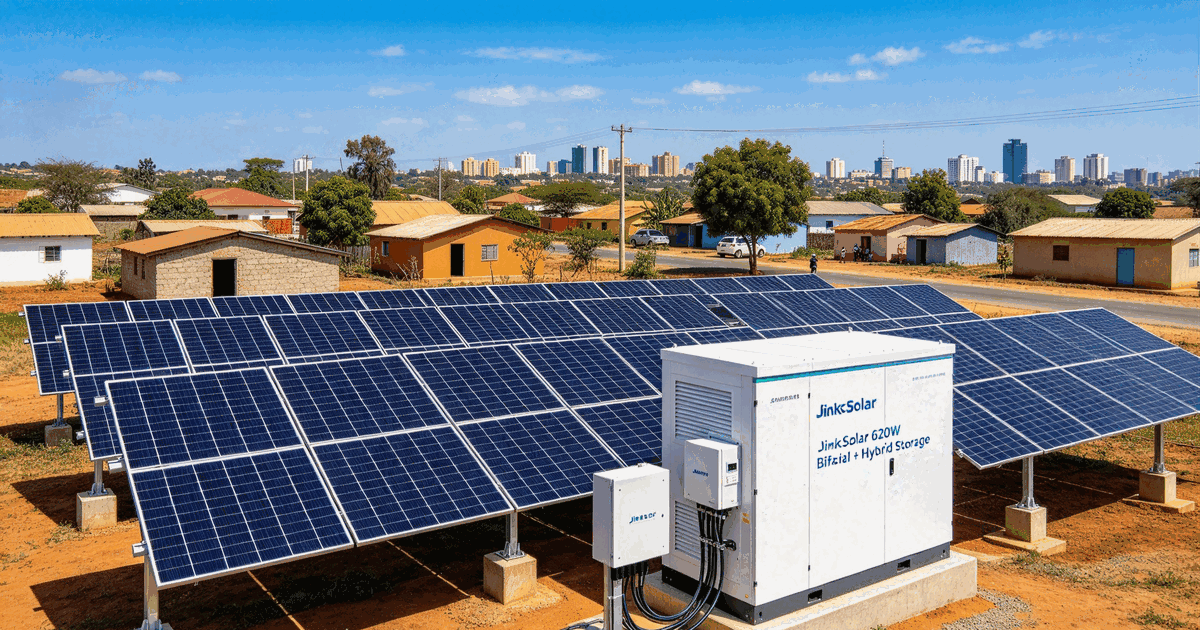
Kenya, Tanzania, Uganda: grid power is unreliable, diesel is $1.40/L, and your clients need 24/7 uptime. This is how to size a 620W bifacial + lithium hybrid system that actually works when the grid drops 6 hours a day.
East Africa's grid infrastructure is improving, but "grid-connected" doesn't mean reliable. In Kenya, Tanzania, and Uganda, scheduled outages run 2-8 hours daily in many areas. Unscheduled blackouts add another 1-4 hours. Diesel backup costs $0.35-0.50/kWh to run when fuel is $1.30-1.50/liter.
The solution isn't pure off-grid solar (oversized and expensive) or grid-tied solar (useless when power drops). It's a hybrid system: solar + battery + grid, with the battery sized to cover realistic outage periods, not 3 days of autonomy you'll never need.
This guide walks through designing a 100kW hybrid system using JinKO 620W bifacial panels (JKM605-630N) paired with 200-300 kWh of lithium storage. Same principles scale from 20kW to 500kW.
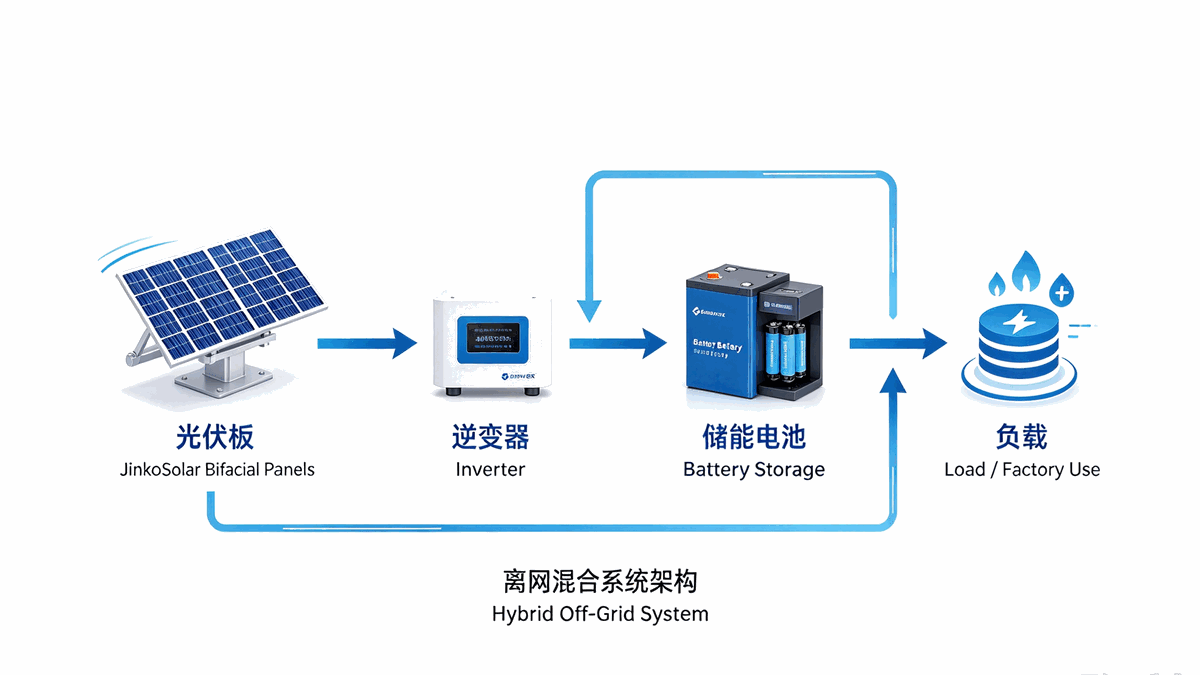
System Architecture: Three Power Paths
A hybrid system needs to:
- Solar → Load (grid up): Panels power the load directly during the day, excess goes to battery or grid export
- Battery → Load (grid down): Battery powers critical loads during outages
- Grid → Load + Battery (night, grid up): Grid powers nighttime loads and optionally recharges battery if solar didn't fill it
Key component: a hybrid inverter (or PV inverter plus battery inverter) with multiple MPPT inputs, a battery interface and an automatic transfer function for outages. Sungrow, GoodWe, Deye, Victron and SMA all make suitable equipment at different sizes and price points.
Load Profile Example: Small Hotel in Nairobi
Before sizing anything, map the client's load:
| Time | Load type | Power (kW) | Critical? |
|---|---|---|---|
| 6am-9am | Kitchen, water heaters, lights | 45 | Yes |
| 9am-5pm | AC (6 units), office, workshop | 65 | Partial (AC non-critical) |
| 5pm-10pm | Kitchen, dining lights, AC (4 units) | 55 | Yes |
| 10pm-6am | Security, fridges, emergency lights | 12 | Yes |
Total connected load: 85 kW peak (2-6pm) Critical load (must run during outage): about 35 kW daytime with air conditioning shed, 12 kW at night Daily consumption: about 1,000 kWh Grid availability: 18-20 hours/day average (4-6 hour daily outage, usually 2-6pm)
Step 1: Solar Array Sizing
Target: Cover 70-80% of Daily Consumption
Why not 100%? Because:
- Battery handles the gap during outages
- Grid is cheaper than oversized solar + storage
- Panel count constrained by roof space
Nairobi solar resource:
- Peak sun hours: 5.8 hours/day average (equatorial, consistent year-round)
- Derating: 0.85 (soiling 3%, inverter 2%, wiring 2%, temp 5%, mismatch 3%)
System sizing:
- Target generation: 750 kWh/day (about 75% of the daily load)
- Required array size: 750 kWh ÷ (5.8 h × 0.85) = 152 kWp
Using JinKO 620W panels:
- Modules needed: 152,000 W ÷ 620 W = 245 panels
- Actual installed capacity: 245 × 620 W = 151.9 kWp
Why 620W Bifacial?
Advantage 1: Bifacial gain on light-colored ground Ground-mounted systems (common in East Africa where rooftops are limited):
- Red soil: 8-12% rear gain
- Dry grass/sand: 12-16% gain
- White gravel: 18-22% gain
For this hotel, ground-mount over compacted dirt: assume 10% bifacial boost → effective capacity 167 kWp.
Advantage 2: Fewer panels = lower BoS cost
- 620W: 245 panels
- 550W alternative: 276 panels (+31 panels = +10% more racking, wire, labor)
Advantage 3: N-type temperature coefficient Nairobi altitude 1,795m means cooler ambient temps (18-26°C), but module operating temp still hits 50-55°C midday.
- N-type (−0.29%/°C): about 8.7% power loss at 55°C
- PERC (−0.36%/°C): about 10.8% loss
- Advantage: about 2% more generation in real-world heat
Step 2: Battery Sizing
Don't Oversize: Match Outage Duration, Not "Days of Autonomy"
Old-school off-grid sizing says "3 days autonomy." That's wrong for hybrid systems where the grid comes back daily.
Outage pattern analysis (Nairobi hotel):
- Typical outage: 4 hours (2pm-6pm)
- Worst case (monthly): 8 hours
- Battery must cover: critical load during outage
Critical load during 4-hour afternoon outage:
- Kitchen + office + security: 35 kW
- Energy needed: 35 kW × 4 h = 140 kWh
Battery sizing with safety margin:
- Usable capacity needed: 140 kWh
- Add 30% margin for battery aging + inefficiency: 140 × 1.3 = 182 kWh
- Lithium DoD (depth of discharge) limit: 90% (to preserve cycle life)
- Battery bank size: 182 kWh ÷ 0.9 = 202 kWh nominal
Specify: 200 kWh lithium LFP (LiFePO₄) battery
- Cycle life: 6,000 cycles at 90% DoD (16+ years at one cycle/day)
- Budget: roughly $85,000-95,000 installed (indicative; battery prices change quickly, so get a current quote)
Battery Chemistry: Why LFP Over NMC
| Parameter | LFP (LiFePO₄) | NMC (Li-ion) |
|---|---|---|
| Cycle life (90% DoD) | 6,000 | 3,000-4,000 |
| Thermal stability | Excellent (safer) | Good |
| Cost ($/kWh) | $420-470 | $380-420 |
| Voltage sag under load | Moderate | Low |
In hot climates (Kenya daytime temps 28-32°C, battery enclosure can hit 40°C), LFP is safer and lasts longer. The 10% cost premium pays back in cycle life.
Step 3: Inverter and Charge Controller Selection
Hybrid Inverter Specs for 152 kW Solar + 200 kWh Battery
Requirements:
- PV input: 152 kWp (size inverter at 1.2:1 DC:AC ratio → 127 kW AC output)
- Battery interface: 200 kWh LFP (nominal voltage 51.2V typical for large systems, or HV 700V for newer inverters)
- Grid connection: 3-phase 400V
- ATS (automatic transfer switch): <50 ms switchover when grid drops
What to check on the inverter datasheet:
- Rated AC output of at least 110-125 kW, so the PV array sits at roughly 1.2-1.4:1 DC:AC
- Enough MPPT inputs to keep strings of equal length on each tracker
- Battery voltage range that matches the LFP system you plan to buy (low-voltage 48V racks or high-voltage stacks)
- Backup (EPS) output rated for the full critical load, with automatic switchover fast enough for computers and refrigeration
- Ability to limit or block grid export where net metering is not available
At this size, one large three-phase hybrid inverter or several smaller units in parallel both work. Parallel units cost a little more but keep part of the system running if one unit fails.
String design for 245 panels:
- Panels per string: 14 in series (Voc = 46.8V × 14 = 655V at STC). Check the cold-morning Voc against the inverter's maximum input voltage. In Nairobi's highlands, early mornings can drop below 10°C.
- 17 strings of 14 = 238 panels. Use the remaining panels in a separate short string only if the inverter has a spare MPPT; otherwise round the design to 238 or 252 panels.
- Spread strings evenly across MPPT inputs to avoid mismatch losses.
Step 4: System Energy Flow (Daily Cycle)
Typical Day (4-Hour Afternoon Outage)
The figures below are a simplified hourly balance for the example hotel. Real systems vary with weather and load, but the totals should roughly add up like this.
6am-9am (sunrise, solar ramping up):
- Load about 135 kWh, solar about 60 kWh
- Grid supplies the remaining ~75 kWh
- Battery stays full from the previous evening
9am-2pm (peak sun):
- Load about 325 kWh, solar about 480 kWh
- ~140 kWh of surplus refills the battery after any morning top-up
- A small remainder is exported or curtailed, depending on the grid rules
2pm-6pm (GRID OUTAGE):
- Air conditioning and the workshop are shed; critical load about 35 kW, so ~140 kWh
- Solar still provides ~210 kWh, more than the critical load on a sunny afternoon
- On cloudy days, the battery covers the gap; this is the case it was sized for
6pm-6am (grid back, no solar):
- Evening and night load about 375 kWh, supplied by the grid
- If the battery was drawn down during the outage, the grid or the next morning's sun recharges it
Daily totals (sunny day):
- Solar generation: ~750 kWh
- Grid import: ~450 kWh, mostly evening and night
- On days when the outage falls after sunset, the battery carries the critical load instead and grid import drops accordingly
Step 5: Financial Analysis
All prices below are indicative planning figures, not a quotation. Exchange rates, tariffs and battery prices move quickly.
System Cost Breakdown (Nairobi, 152 kW + 200 kWh)
| Component | Quantity | Unit price | Total |
|---|---|---|---|
| JinKO 620W panels | 245 | $80 | $19,600 |
| Hybrid inverter(s), ~125 kW total | 1 lot | $18,500 | $18,500 |
| 200 kWh LFP battery | 1 system | $90,000 | $90,000 |
| Racking (ground mount) | 152 kW | $65/kW | $9,880 |
| DC cabling + breakers | 1 lot | $6,500 | $6,500 |
| AC panel + transfer switch | 1 lot | $4,200 | $4,200 |
| Installation labor | 18 days | $1,100/day | $19,800 |
| Shipping + customs (Kenya) | 1 lot | $12,000 | $12,000 |
| Total installed cost | $180,480 |
Annual Cost With the Hybrid System
Assumes grid power at about $0.18/kWh.
| Item | Cost/year |
|---|---|
| Grid electricity (450 kWh/day × 365 × $0.18) | $29,600 |
| Battery replacement reserve ($90,000 spread over 16 years) | $5,600 |
| O&M (cleaning, inspection, minor repairs) | $2,800 |
| Total | $38,000 |
Annual Cost Without Solar (Grid + Diesel Backup)
The hotel runs a generator for its 4-hour daily outage, covering the full afternoon load.
| Item | Cost/year |
|---|---|
| Grid electricity (about 740 kWh/day × 365 × $0.18) | $48,600 |
| Diesel for outages (about 260 kWh/day × 365 × $0.40/kWh fuel cost) | $38,000 |
| Generator maintenance | $3,200 |
| Total | $89,800 |
Annual savings with the hybrid system: about $51,800 Simple payback: $180,480 ÷ $51,800 = about 3.5 years
Payback is very sensitive to how many hours the generator actually runs. If outages are only 1-2 hours a day, savings fall and payback stretches to 5-7 years. If outages are longer or diesel is more expensive, payback gets shorter.
Design Mistakes to Avoid
Mistake 1: Oversizing the Battery
"3 days autonomy" sounds safe, but:
- 3 days × 1,000 kWh/day = 3,000 kWh of storage, roughly 15 times the battery in this design
- Outages in most East African cities rarely last more than 12 hours
- Most of that capacity would sit unused almost every day
Right-size for actual outage patterns. Add a small diesel genset (20 kW) as emergency backup for the rare 24+ hour blackout.
Mistake 2: Not Accounting for Battery Roundtrip Efficiency
Lithium battery: 95% efficient one-way, 90% roundtrip.
- 100 kWh solar → battery → load: you get 90 kWh usable
- In financial models, derate battery throughput by 10%
Mistake 3: Ignoring Grid Recharge Limits
If your grid connection is 80A 3-phase (55 kW), and the load is 50 kW, you only have 5 kW available to recharge the battery.
- 200 kWh battery ÷ 5 kW = 40 hours to recharge (won't finish overnight)
Solution: Size battery so it recharges within available grid hours, or upgrade the grid connection.
Mistake 4: Bifacial Panels Mounted Too Low
Bifacial rear gain requires clearance:
- <30 cm: 5-8% gain
- 50 cm: 12-16% gain (optimal)
-
80 cm: diminishing returns
Mount at 50-60 cm for ground systems.
Product Specs: JinKO 620W for Hybrid Systems
Model: JKM605-630N-66HL4M-BDV-F6 Power: 605-630W (specify 620W bin for best $/W) Efficiency: 23.24% Bifacial factor: 70% Temp coefficient: −0.29%/°C Voc: 46.8V (string of 14 = 655V, safe for 1000V systems) Isc: 13.86A Weight: 30.8 kg Dimensions: 2172 × 1303 × 30 mm
Why this module for hybrid:
- Voltage matches common hybrid inverter input ranges (450-850V MPPT)
- N-type low degradation means battery pays back over full 20-year life
- Bifacial gain reduces panel count = lower BoS
- 30-year warranty outlasts the battery (16 years) and inverter (12 years)
XinHaoYang supplies JinKO solar panels, hybrid inverters, and LFP batteries to East Africa with technical system design support. Contact for site-specific load analysis and bankable energy models.
Regional Considerations
Tariffs, net metering rules and import duties change often in East Africa. Treat the points below as a checklist and confirm current figures with the utility and your clearing agent before you finalise a design.
Kenya
- Commercial grid tariffs are among the higher ones in the region once fuel and levy charges are included
- Net metering rules exist, but approval takes time; many commercial systems are designed for little or no export
- Solar panels have generally received favourable import treatment; check whether batteries and inverters qualify for the same exemption on your shipment
Tanzania
- Outages are frequent in many areas, which makes battery storage more valuable
- Grid export is not widely available, so design for self-consumption with export limiting
- Duty treatment of batteries and inverters can differ from solar panels; confirm the HS codes with your clearing agent before shipping
Uganda
- Grid tariffs for commercial users are relatively high, which improves solar payback
- Net metering is limited, so size the system for self-consumption
- Confirm the exemption status of each component under EAC rules before ordering
Why duty matters: the battery is about half the system cost. A difference of 10-25% in duty on the battery alone can move payback by six months or more. Ask your supplier to list panels, inverters and batteries as separate invoice lines with correct HS codes.
The Bottom Line
Hybrid solar isn't "off-grid lite." It's the most cost-effective solution for East Africa's unreliable-but-present grid.
Key sizing rules:
- Solar: 70-80% of daily consumption (not 100%)
- Battery: 1-1.5× daily outage duration (not 3 days)
- Inverter: 1.2× peak load for motor starting
- Use bifacial panels on light ground for 10-15% free capacity boost
When hybrid beats pure grid-tied:
- Outages >2 hours/day
- Critical loads that can't tolerate downtime
- Diesel backup costs more than about $0.25/kWh
When hybrid beats off-grid:
- Grid is available >60% of the time
- You don't need 3-day autonomy
- You want a much smaller battery than a full off-grid system would need
For a 100-150 kW commercial facility in Nairobi, Dar es Salaam, or Kampala with 4-6 hour daily outages, expect:
- Installed cost: roughly $1,100-1,350 per kW of solar, including storage
- Payback: about 3.5-7 years, depending mainly on how many hours the generator would otherwise run
- Savings: often $25,000-50,000/year against grid plus diesel
XinHaoYang supplies JinKO panels, hybrid inverters, and LFP batteries to East Africa with technical system design support. Contact for site-specific load analysis and bankable energy models.
Jack Chen | ivy@longijinko.com | WhatsApp +86 189 0619 0578
Have Questions About This Article?
Our technical team is here to help you choose the right solar solution for your project.