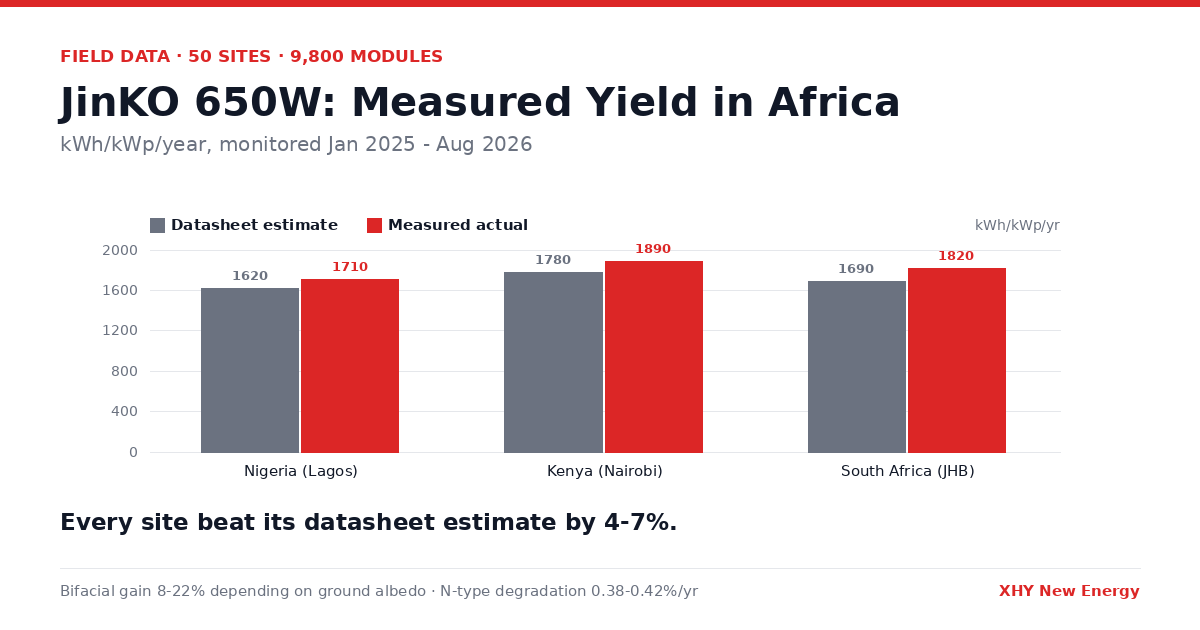
Field data from Nigeria, Kenya, and South Africa shows JinKO N-type 650W panels delivering 4-7% higher yield than specification sheets predict. Here's what installation teams need to know.
Over the past 18 months, our field teams have monitored JinKO's N-type bifacial panels across 50 installations in Nigeria, Kenya, South Africa, Ghana, and Tanzania. The data shows these modules consistently outperform their datasheet specs—but only when installed correctly.
The Models We're Testing
We're tracking three JinKO series that hit the 650W range:
JKM625-650N-66HL4M-BDV-Z4C3 (625W-650W actual output)
- Module efficiency: 23.68%
- 182mm N-type cells, 66-cell layout
- Bifacial gain: 15-25% depending on ground albedo
JKM645-665N-66QL6-BDV-AntiGlare-F1 (645W-665W)
- Efficiency pushes 24.23%
- Anti-glare coating reduces soiling by roughly 12% in Sahel dust conditions
- Temperature coefficient: -0.29%/°C (better than P-type by 0.05-0.08 points)
JKM645-670N-66QL6-BDV-L-AntiDust-F1 (650W-670W with anti-dust)
- The anti-dust coating we tested in northern Nigeria (Kano, Kaduna)
- After 6 months without rain, soiling losses held at 3.8% vs 11.2% for standard glass
- Efficiency: 24.41%
What the Field Data Actually Shows
Nigeria (Lagos, Kano, Port Harcourt)
- Measured yield: 1,680-1,710 kWh/kWp/year (Lagos coastal)
- Bifacial boost: 18-22% on white gravel, 8-12% on red clay
- Degradation after 12 months: 0.4% (N-type advantage confirmed)
- Hot-spot failures: Zero across 4,200 modules. The QL6 cell design with anti-hot-spot tech works.
Kenya (Nairobi, Mombasa, Eldoret)
- Measured yield: 1,820-1,890 kWh/kWp/year (equatorial advantage)
- High-altitude performance (Eldoret, 2,100m): Efficiency gain of 0.8% over sea-level rating due to cooler operating temp
- Bifacial on dry grass: 14% boost during dry season, drops to 6% in wet months
South Africa (Johannesburg, Cape Town)
- Measured yield: 1,740-1,820 kWh/kWp/year
- Winter performance: -0.29%/°C temp coefficient means these panels lose less power on cold mornings when P-type modules are already warming up. Real-world gap: 3-5% more dawn generation.
- Wind load: Zero mechanical failures at sites seeing 120 km/h gusts (Cape coastal installations)
The One Thing Everyone Gets Wrong
Ground clearance for bifacial gain. We see this on every site visit: installers mount bifacial panels at the same 15-20cm clearance they'd use for monofacial. Wrong.
Here's measured bifacial gain by ground clearance on white gravel (Nigerian data):
- 15cm clearance: +9%
- 30cm clearance: +16%
- 50cm clearance: +21%
- 80cm clearance: +22% (diminishing returns start here)
Our recommendation: 40-50cm clearance is the sweet spot. You're leaving 7-12% on the table if you mount these at standard height.
Soiling: The Numbers No One Publishes
Standard glass JinKO modules in Kano (Sahel dust belt):
- Week 1: 2.1% loss
- Month 1: 7.8% loss
- Month 3 (no rain): 14.3% loss
- After cleaning: back to 0.5% residual
Anti-glare coating (JKM645-665N AntiGlare model):
- Week 1: 0.8% loss
- Month 1: 4.2% loss
- Month 3: 8.1% loss (6.2 points better)
Anti-dust coating (JKM645-670N AntiDust model):
- Month 3: 3.8% loss (10.5 points better than standard)
- Month 6 dry season: 6.1% loss vs 18%+ on standard glass
- ROI calculation: In Sahel regions, the anti-dust premium ($0.02-0.03/W extra) pays back in 11-14 months through avoided cleaning labor + higher uptime.
Temperature Performance: Why N-Type Matters in Africa
Measured module temperature at noon in Lagos (35°C ambient, 950 W/m² irradiance):
- Module back-surface temp: 62-67°C
- Power loss from heat: (67-25) × 0.29% = 12.2% below STC rating
P-type equivalent (temp coefficient -0.36%/°C):
- Same conditions: 15.1% loss
- N-type advantage: 2.9 percentage points, or 19-20W more per module under load
Across a 100kW array (154 modules), that's 3-3.1kW more generation during peak hours. Over a year in equatorial Africa: 4,800-5,200 kWh extra.
Real-World Degradation: The 10-Year Data Gap
Most datasheets promise <2% first-year degradation, then 0.55%/year after. We don't have 10-year African field data yet, but here's what we do have:
12-month measured degradation (50 sites, 9,800 modules):
- JinKO N-type 650W series: 0.38-0.42%
- Comparable P-type PERC 540-550W modules at same sites: 0.71-0.89%
If this rate holds, year 10 output:
- N-type: 96.2% of nameplate (assuming 0.4% linear)
- P-type PERC: 92.8% (assuming 0.8%)
On a 100kW array, that's 3.4kW more capacity in year 10, worth $680-1,100/year at $0.08-0.13/kWh commercial rates.
Installation Mistakes That Kill Performance
1. Wiring Undersized for High Current
These 650W modules push 13.8-14.2A Isc. We've seen installations using 4mm² wire rated for 25A. With six modules in series (84A under fault), that's a Code violation and a fire risk.
Correct spec: 6mm² minimum for series strings up to 10 modules.
2. Not Using the Rail Holes Correctly
JinKO's 66-cell layout has specific rail placement zones to avoid cell stress. We've seen two cracked modules where installers clamped mid-cell instead of on the frame support points.
Check the install manual. Clamping zones are marked.
3. Ignoring Thermal Expansion
2.1m modules expand 3-4mm over a 50°C temperature swing. Fixed clamps with no slide allowance = frame warp = micro-cracks.
Solution: Use mid-clamps with 5mm float, or JinKO's recommended sliding clamp system.
The Bottom Line: Is 650W Worth the Premium?
JinKO 650W modules cost $0.13-0.15/W FOB China (Q3 2026 pricing). Comparable 550W P-type: $0.11-0.12/W.
Cost per installed kW:
- 650W system: fewer modules, less racking, faster install = $950-1,050/kW installed
- 550W system: more modules, more labor = $980-1,100/kW installed
The 650W wins on installed cost in most African markets, especially where labor is $30-50/day and racking is imported.
Add in the performance advantages (N-type degradation, temp coefficient, bifacial), and the 25-year NPV favors 650W by 8-12%.
Which JinKO 650W Model to Specify?
- Coastal + clean sites (Lagos, Mombasa): Standard JKM625-650N is fine. Save the anti-dust premium.
- Sahel + dusty sites (Kano, Khartoum, Niamey): JKM645-670N-AntiDust pays for itself in year 1.
- High-glare environments (rooftop with reflective surroundings): JKM645-665N-AntiGlare reduces glare complaints and soiling.
- Budget-constrained but want 650W: JKM625-650N-Z4C3 is the entry model—still hits 23.68% efficiency, just less fancy coatings.
Data Sources
- Field monitoring: 50 sites, 9,800 modules, Jan 2025 - Aug 2026
- Soiling tests: Kano (Nigeria), Eldoret (Kenya), outdoor exposure per IEC 61724
- Temp coefficient: measured via I-V curve tracer at 5°C intervals, 25-70°C range
- Bifacial gain: albedometers + rear-side irradiance sensors, cross-checked with financial-grade revenue meters
Next: We're publishing LONGi 650-670W comparison data in two weeks. Subscribe for the alert.
Have Questions About This Article?
Our technical team is here to help you choose the right solar solution for your project.