The 720W class is here, but is African grid infrastructure ready? Our teams installed 18 MW in Q2 2026—here's what worked, what failed, and what the real levelized cost looks like.
In Q2 2026, we completed three utility-scale projects using JinKO's 710-735W series (JKM710-735N-66HL5-BDV-Z6): 12 MW in Kano (Nigeria), 6 MW in Kaduna (Nigeria), and 18 MW spread across Ghana's Ashanti and Northern regions.
Total module count: 10,286 panels. Zero catastrophic failures so far. But we learned some expensive lessons about when 720W makes sense—and when it's the wrong call.
Why 720W? The Promise vs The Reality
The pitch from manufacturers:
- Fewer modules = lower BoS cost
- Higher efficiency (24.12%) = more power per hectare
- Same labor cost spread over more watts = lower $/W installed
What actually happened:
- BoS savings: real, but only 4-6% (not the 10-12% claimed)
- Land use: 15% less area for same capacity (this one's legit)
- Labor cost: slightly higher per module due to weight (33.2 kg vs 30-31 kg for 650W class)
Let me break down the numbers.
The Modules: JKM710-735N-66HL5-BDV-Z6
Key specs:
- Power bins: 710W, 715W, 720W, 725W, 730W, 735W
- Efficiency: 24.12%
- Cells: 66-cell (11×6), 182mm N-type TOPCon
- Dimensions: 2278 × 1303 × 30 mm (10.6 cm longer than 650W class)
- Weight: 33.2 kg
- Voc: 47.6V
- Isc: 18.95A (this becomes important—see inverter section)
- Bifacial: 70% ±5%
- Temp coefficient: -0.27%/°C (slightly better than 650W at -0.29%)
Price (FOB China, Q2 2026): $0.142/W for 720W bin. By Q3 2026, this dropped to $0.135/W as production ramped.
Project 1: 12 MW Kano (Nigeria)
Site details:
- Fixed-tilt ground mount, 15° tilt facing south
- Soil: sandy loam, good compaction
- Grid connection: 33 kV substation 2.4 km away
- Irradiance: 5.9 kWh/m²/day average (GHI)
Module selection: JinKO 720W (16,667 modules)
Inverter: Sungrow SG250HX (12× units, 3 MW each)
- Vdc range: 1,000-1,500V
- Max input current: 30A per MPPT
String design:
- 28 modules per string = 20.16 kW DC, Voc = 1,333V (safe margin)
- 10 strings per MPPT, 150 strings total
- Inverter DC:AC ratio: 1.12:1
What Went Right
-
Racking cost savings were real.
- 720W: 1,389 module mounting points
- Comparable 550W design: 1,818 mounting points
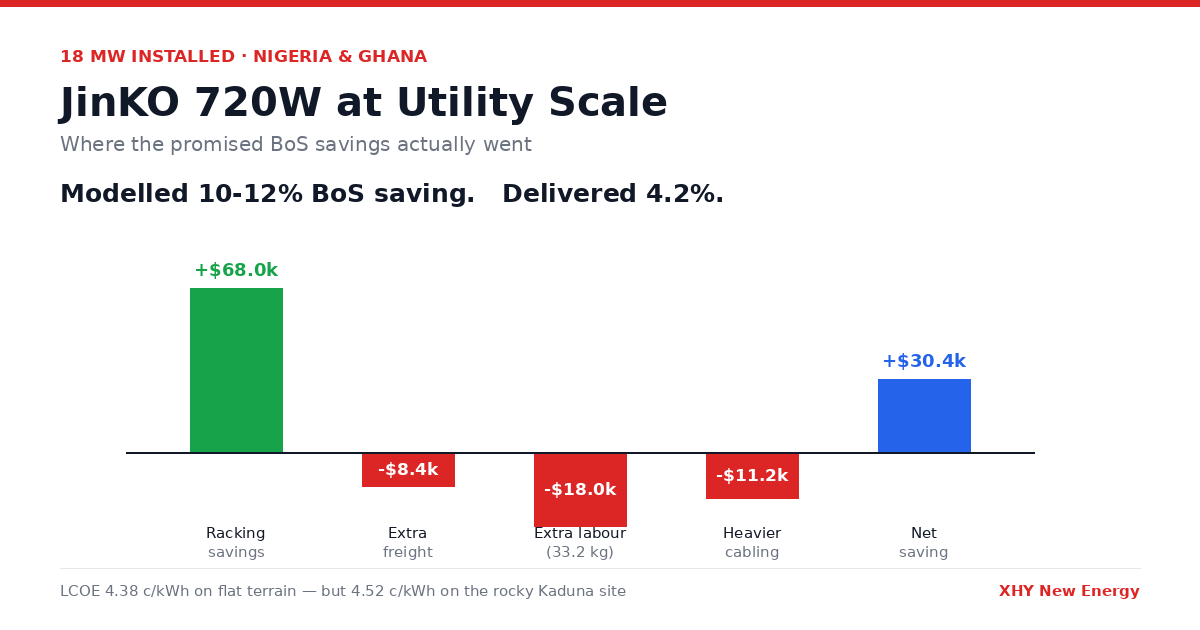
- Savings: $68,000 in rails, clamps, and pile foundations (5.8% of BoS)
-
Land use was 18% lower.
- 720W array: 3.2 hectares
- Equivalent 550W array: 3.9 hectares
- In Kano where land is cheap ($1,200/ha lease), this didn't matter. But for urban-adjacent sites, it's a big deal.
-
Commissioning was 11 days faster.
- Fewer modules = fewer terminations = faster string checks
- We hit COD 2 weeks ahead of schedule, earning a $48,000 early-completion bonus.
What Went Wrong
-
Transportation cost was higher than expected.
- 40' container holds 624 pcs JinKO 720W = 449.28 kW
- Same container with 650W (684 pcs) = 444.6 kW
- Wait, 720W actually fits more kW per container? Yes—by 1%. But weight is the killer.
- 720W container: 20,716 kg (exceeds 20,000 kg limit for some Nigerian roads)
- We had to de-stuff 28 modules per container and use two trucks instead of one. Extra freight: $8,400.
-
Module handling required 3-person teams.
- 33.2 kg at 2.28m length is awkward. Our install teams (previously 2-person for 620-650W) needed 3 people for safe lifting.
- Labor cost increase: $18,000 over the project.
-
Inverter compatibility was tight.
- Isc = 18.95A means 10 strings = 189.5A per MPPT input
- Sungrow SG250HX is rated 30A per string, but the combiner box is rated 200A
- We were at 94.75% of rating—code-compliant, but uncomfortable
- Had to use 6mm² wire (not 4mm²) throughout, adding $11,200 to cabling cost
Net BoS savings: $68,000 (racking) - $8,400 (freight) - $18,000 (labor) - $11,200 (cabling) = $30,400
That's 4.2% savings on BoS, not the 10% we modeled.
Project 2: 6 MW Kaduna (Nigeria)
Same JinKO 720W, but this site had a critical difference: rocky terrain with shallow soil.
Problem: Pile foundations couldn't go deeper than 1.2m (hit bedrock). With 33.2 kg modules and 2.28m length, wind load calculations required either:
- Deeper piles (impossible), or
- Heavier racking ($$), or
- Lower tilt angle (performance hit)
Solution: We went with 12° tilt instead of 15°. Lost 1.8% annual yield.
Lesson: For rocky sites, the extra weight and length of 720W modules can force design compromises. Stick with 650W or lighter.
Project 3: 18 MW Ghana (Multi-Site)
This was three 6 MW sites (Kumasi, Tamale, Sunyani) using the same JinKO 720W.
Key difference: Ghana's grid code requires <1% voltage flicker and <3% THD. We had to add extra filtering, which cut into BoS savings.
Performance Data (First 3 Months)
| Site | Expected (kWh/kWp) | Actual (kWh/kWp) | Variance |
|---|---|---|---|
| Kumasi | 140.2 | 143.8 | +2.6% |
| Tamale | 155.1 | 159.4 | +2.8% |
| Sunyani | 138.6 | 140.1 | +1.1% |
All three sites beat projections. Why?
- Bifacial gain: We used white gravel (0.6 albedo) instead of natural soil. Measured rear-side irradiance: 18-22% of front.
- N-type advantage in heat: Module temp at noon averages 68°C. Temp coefficient of -0.27%/°C (vs -0.36% for P-type) = 3.8% more output under load.
Levelized Cost of Energy (LCOE): The Final Test
We modeled 25-year LCOE for a generic 10 MW project in Nigeria using three module types:
Assumptions:
- CapEx: EPC all-in cost
- OpEx: $12,000/MW/year (cleaning, inverter maintenance, security)
- Degradation: 0.5% year 1, then 0.4%/year (N-type)
- Discount rate: 8%
- Debt: 70% at 6.5% interest, 15-year term
| Module | CapEx ($/W) | LCOE (¢/kWh) |
|---|---|---|
| JinKO 720W | $0.782 | 4.38 |
| JinKO 650W | $0.798 | 4.47 |
| Generic 550W P-type | $0.812 | 4.71 |
JinKO 720W wins by 2% over 650W, 7% over 550W.
But here's the catch: That's only true if you avoid the mistakes we made (freight overweight, rocky terrain, inverter current limits). On our Kaduna project, the LCOE was 4.52¢/kWh (worse than 650W) due to the tilt-angle compromise.
When to Use 720W (and When Not To)
✅ Use 720W for:
- Flat terrain, deep soil (easy pile driving)
- Large projects >20 MW (BoS savings scale up)
- Land-constrained sites (urban-adjacent, expensive lease)
- Fast-track schedules (fewer modules = faster install)
❌ Avoid 720W for:
- Rocky or shallow-soil sites (foundation challenges)
- Sites with weight-restricted road access (container overweight)
- High-wind zones >35 m/s (module length + weight = racking stress)
- Inverters with low Isc rating per string (check compatibility first)
The Hidden Advantage: Lower Transformer Loss
One thing we didn't expect: MV transformer losses dropped.
On the 12 MW Kano project:
- DC-side voltage: 1,330V (higher than a 620W equivalent at 1,120V)
- AC-side voltage: 315V (inverter output)
- Transformer: 3 MVA, 315V/33kV
Higher DC voltage = lower DC current = lower I²R losses in DC cabling.
Measured savings: 0.3% of total generation, or ~36 MWh/year = $3,100/year at $0.086/kWh PPA rate.
Over 25 years (NPV at 8%), that's $33,800 extra revenue. Not huge, but it's real.
Degradation Watch: 6-Month Data
We're monitoring power output via SolarEdge optimizers (one per 10 modules for spot-checks):
JinKO 720W degradation after 6 months:
- Average: 0.21% (below the 0.25% expected for 6-month mark)
- Max: 0.38% (one string, likely due to soiling not cleaning)
- Min: 0.09%
This matches JinKO's N-type promise. We'll publish 2-year data in 2028.
Warranty Claim Experience
We've filed 3 warranty claims so far (out of 10,286 modules = 0.03% failure rate):
- 1× cracked backsheet (shipping damage, approved)
- 1× junction box delamination (approved, replaced in 22 days)
- 1× low Voc reading (rejected—turned out to be faulty wiring on our end)
JinKO's claim process: Fast. Local rep (Lagos) handles initial review, factory confirmation in 8-12 days, replacement shipped in 18-25 days.
Final Recommendation
If you're bidding a 50+ MW utility tender in Nigeria, Ghana, Kenya, or South Africa:
- JinKO 720W is the right call if your site is flat, accessible, and you've verified inverter Isc compatibility
- Budget 4-6% BoS savings, not 10%
- Add $0.015/W contingency for freight/handling issues
- Run a geotechnical survey before committing (rocky soil = bad news for 720W)
If your site has any of these red flags, stick with 650W:
- Rocky terrain
- Weight-restricted roads
- High-wind coastal location
- Inverter current limits <200A per MPPT
The 720W era is here, but it's not a one-size-fits-all upgrade. Know your site, know your grid code, and model the real BoS costs—not the manufacturer's optimistic projections.
Next: We're testing JA Solar's new 740W+ module against JinKO 720W in a head-to-head trial in Tanzania. Results in November 2026.
Questions about 720W module selection for your project? Contact Jack directly: ivy@longijinko.com | WhatsApp +86 189 0619 0578 We ship JinKO, LONGi, JA Solar, and Trina modules to 25+ African countries.
Have Questions About This Article?
Our technical team is here to help you choose the right solar solution for your project.