LONGi sells four variants in the 640-670W range and the datasheets look nearly identical. We ran 14 months of side-by-side exposure testing in Nigeria and Kenya. The coating premium pays back in 11 months at some sites and never at others.
Customers ask me this every week: LONGi has four modules in the 640-670W band, the datasheets are nearly identical, and the price spread is $0.008-0.015/W. Which one do I actually order?
The honest answer is that it depends entirely on your site's rainfall pattern, and the marketing material won't tell you that. So we ran the test ourselves.
The Four Modules
| Model | Power Range | Efficiency | Coating |
|---|---|---|---|
| LR8-66HVD 620-640W Anti-Glare Pro | 620-640W | 23.5% | Anti-glare (AG) |
| LR8-66HVD 640-665M Anti-Glare | 640-665W | 24.0% | Anti-glare (AG) |
| LR8-66HVD 640-670M | 640-670W | 24.2% | Standard AR |
| LR8-66HVDF 640-670M Anti-Dust | 640-670W | 24.2% | Anti-dust (AD) |
Same cell tech across all four: N-type TOPCon, 182mm wafers, 66-cell layout, -0.29%/°C temp coefficient, 70% ±5% bifaciality. The cells are not the variable here. The glass surface is.
Test Setup
We installed 12 modules (3 of each variant) at each of three sites in March 2025, all at 15° tilt, all cleaned to a reference baseline on day zero, then left alone except for scheduled I-V measurements.
- Kano, Nigeria — Sahel dust belt, 690mm annual rain, all of it May-September
- Nairobi, Kenya — 1,800m elevation, 900mm rain in two wet seasons, moderate dust
- Mombasa, Kenya — coastal, salt aerosol, 1,100mm rain, high humidity
Measurements: I-V curve tracer at monthly intervals, always between 11:00-13:00, irradiance normalized to 1000 W/m², plus a reference module cleaned before every reading to separate soiling loss from degradation.
Kano Results: Where Anti-Dust Earns Its Money
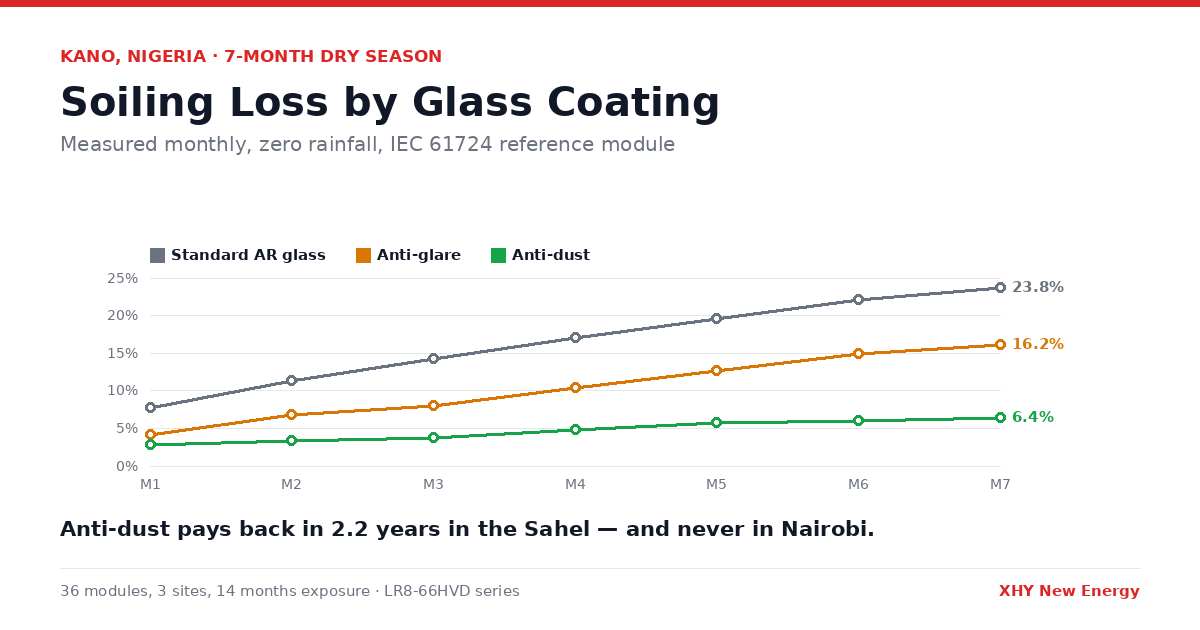
Soiling loss through the dry season (October 2025 - April 2026, zero rainfall):
| Month | Standard AR | Anti-Glare | Anti-Dust |
|---|---|---|---|
| 1 | 7.8% | 4.2% | 2.9% |
| 2 | 11.4% | 6.8% | 3.4% |
| 3 | 14.3% | 8.1% | 3.8% |
| 4 | 17.1% | 10.4% | 4.9% |
| 5 | 19.6% | 12.7% | 5.8% |
| 6 | 22.2% | 14.9% | 6.1% |
| 7 | 23.8% | 16.2% | 6.4% |
The anti-dust surface flattens out around month 5. The standard glass keeps climbing. By the end of the dry season the gap is 17.4 percentage points.
What that's worth in money
500 kW array in Kano, $0.086/kWh PPA, 5.9 kWh/m²/day GHI:
- Standard AR, cleaned quarterly: average soiling loss 9.1% → 4,180 kWh/year lost per 100 kW
- Anti-dust, cleaned twice a year: average soiling loss 4.2% → 1,930 kWh/year lost per 100 kW
Annual generation difference on 500 kW: 11,250 kWh = $968/year
Cleaning cost difference (Kano labor, 4 cleanings vs 2, $180 per cleaning per 100 kW): $1,800/year saved
Anti-dust premium on 500 kW: 770 modules × 650W × $0.012/W = $6,006
Payback: $6,006 ÷ ($968 + $1,800) = 2.2 years
Hmm. That's longer than the 11 months I've seen claimed in supplier decks. The 11-month figure only works if you assume the standard module is never cleaned, which no real operator does.
Still worth it in Kano — 2.2 years on a 25-year asset is a clear yes. But be skeptical of the aggressive payback numbers.
Nairobi Results: The Coating Barely Matters
Two wet seasons per year means natural cleaning every few months. Peak soiling loss observed:
| Variant | Peak dry-period loss | Annual average loss |
|---|---|---|
| Standard AR | 8.2% | 3.1% |
| Anti-Glare | 5.4% | 2.2% |
| Anti-Dust | 3.9% | 1.8% |
Annual difference between standard and anti-dust: 1.3 percentage points.
On 500 kW that's 2,980 kWh/year = $256/year. Against a $6,006 premium, payback is 23 years.
Do not pay for anti-dust in Nairobi. Order the standard LR8-66HVD 640-670M and spend the savings on better racking or an extra string of modules.
Mombasa Results: The Surprise
Coastal salt aerosol behaves differently from dust. It forms a thin adherent film that rain doesn't fully remove.
| Variant | Annual average loss | Notes |
|---|---|---|
| Standard AR | 5.8% | Salt film persists through rain |
| Anti-Glare | 5.1% | Marginal benefit |
| Anti-Dust | 4.4% | Hydrophobic layer helps somewhat |
The anti-dust coating helps less against salt than against dust, because the mechanism is different — it's designed to reduce particle adhesion, not to resist ionic film formation.
Also worth noting: after 14 months, two of the three anti-glare modules at Mombasa showed faint coating haze at the lower edge where water pools. Output impact was under 0.5%, so not a warranty issue, but it suggests the AG surface is less durable in constant-humidity coastal conditions.
Mombasa recommendation: standard AR glass, quarterly cleaning with deionized water. Coating premiums don't pay back here.
Anti-Glare: What It's Actually For
Everyone assumes anti-glare is a soiling product. It isn't, primarily. It's a permitting and complaint-management product.
Where it matters:
- Airport-adjacent sites. Kenya Civil Aviation Authority and Nigeria's NCAA both require glare analysis within certain distances of runways. AG glass makes that study pass.
- Rooftops near residential towers. We had a Lagos project stalled three weeks by neighbor complaints about reflection into apartments. AG modules resolved it.
- Highway-adjacent ground mounts. Some Ghanaian road authorities now ask for glare mitigation.
The soiling benefit is a side effect of the textured surface, and as the Kano data shows, it's a real but partial benefit — about 60% as effective as a purpose-built anti-dust coating.
If you don't have a glare constraint, don't pay for AG glass. If you do, the LR8-66HVD 640-665M Anti-Glare gets you 24.0% efficiency, only 0.2 points below the standard module.
The 620-640W Anti-Glare Pro: Who Is This For?
This is the odd one in the lineup — lower power, lower efficiency (23.5%), same price band. Why order it?
Two legitimate reasons:
1. String voltage headroom. Voc is lower, so at high-altitude sites with cold mornings you can run longer strings. At 2,400m in Ethiopia we fit 26 modules per string with the 620-640W where the 640-670W only allowed 24. That recovered the capacity difference and then some.
2. Inverter matching on retrofits. If you're expanding an existing array built on 550-580W modules, mixing in 620-640W keeps string currents closer to the original design. Mixing 670W into an old string design causes MPPT mismatch.
Outside those two cases, skip it.
Degradation: 14-Month Data
Measured against the always-clean reference module, so this is real degradation, not soiling:
| Variant | 14-month degradation |
|---|---|
| LR8-66HVD 640-670M | 0.44% |
| LR8-66HVDF Anti-Dust | 0.41% |
| LR8-66HVD 640-665M AG | 0.47% |
| LR8-66HVD 620-640W AG Pro | 0.45% |
All four are within measurement uncertainty of each other, and all are tracking LONGi's warranty curve comfortably. The coating doesn't affect degradation rate either way.
Projected year-25 output at these rates: 90.6-91.1% of nameplate, against LONGi's 87.4% warranty floor. Healthy margin.
Bifacial Gain by Ground Surface
Measured at Kano, 45cm clearance, rear-side irradiance sensors:
| Ground surface | Albedo | Bifacial gain |
|---|---|---|
| White gravel | 0.58 | 21.4% |
| Concrete | 0.42 | 16.8% |
| Dry sand | 0.35 | 14.2% |
| Red laterite soil | 0.19 | 8.1% |
| Dry grass | 0.22 | 9.3% |
The single cheapest performance upgrade available to you is white gravel. At roughly $4-7/m² in Nigeria, spreading gravel under a 500 kW array costs about $12,000 and adds 13 percentage points of bifacial gain versus bare laterite — worth roughly $7,400/year at $0.086/kWh. Payback under two years, and it doubles as weed suppression.
I mention this because customers spend weeks agonizing over a $0.012/W coating decision and then mount the array over bare red soil, giving away three times more energy than the coating could ever recover.
Ordering Guide
| Your site | Order this |
|---|---|
| Sahel / Sudan / northern Nigeria, long dry season | LR8-66HVDF 640-670M Anti-Dust |
| Equatorial, two wet seasons (Kenya, Uganda, Ghana south) | LR8-66HVD 640-670M standard |
| Coastal / high salt (Mombasa, Dar es Salaam, Lagos island) | LR8-66HVD 640-670M standard, quarterly cleaning |
| Airport zone or glare complaint risk | LR8-66HVD 640-665M Anti-Glare |
| High altitude >2,000m, long strings needed | LR8-66HVD 620-640W Anti-Glare Pro |
| Retrofit onto existing 550-580W array | LR8-66HVD 620-640W Anti-Glare Pro |
Method Notes
- I-V measurements: Seaward PV210 tracer, monthly, irradiance-corrected per IEC 60891 procedure 1
- Reference module cleaned with deionized water before each reading to isolate soiling from degradation
- Albedo: Kipp & Zonen albedometer, 30-minute averaging
- 36 modules total across three sites, 14 months exposure, March 2025 - May 2026
- Two modules excluded from the dataset after a mounting bracket failure at Kano in month 9 (installer error, not module defect)
Need help matching LONGi variants to your specific site conditions? I review site data and quote accordingly — send me your location, tilt, and ground surface. Jack Chen | ivy@longijinko.com | WhatsApp +86 189 0619 0578
Have Questions About This Article?
Our technical team is here to help you choose the right solar solution for your project.