Side-by-side installation data from Kenya and Tanzania shows the 620W class still dominates utility bidding—but 650W has a hidden advantage for rooftop commercial. Here's the financial breakdown.
We manage procurement for 80+ MW of installations across Kenya, Tanzania, Uganda, and Rwanda. Every tender comes down to the same question: Do we go high-wattage (650W+) or stick with the proven 620W class that's been dominating African utility tenders since 2024?
Here's what the numbers actually show—broken down by project type.
The Two Modules Everyone's Quoting
LONGi LR8-66HVD 640-670M (our focus: 650W bin)
- Efficiency: 24.2%
- Dimensions: 2172 × 1303 × 30 mm
- Weight: 31.5 kg
- Temp coefficient: -0.29%/°C (N-type)
- Bifacial: 70% ±5%
- Price (FOB China, Q3 2026): $0.138/W
JinKO JKM605-630N-66HL4M-BDV-F6 (our focus: 620W bin)
- Efficiency: 23.24%
- Dimensions: 2172 × 1303 × 30 mm
- Weight: 30.8 kg
- Temp coefficient: -0.29%/°C (N-type)
- Bifacial: 70% ±5%
- Price (FOB China, Q3 2026): $0.132/W
Same footprint. Same tech. 30W difference. $0.006/W price gap. So why is 620W still winning 65% of East African utility tenders?
Cost Per Installed Watt: The Real Comparison
Let's model a 5 MW ground-mount project in Kenya (Nakuru region, grid-connected PPA).
Scenario A: LONGi 650W
- Modules needed: 7,693 pcs
- Module cost: $1,061,634
- Racking (fixed tilt): $192,325 (fewer rows)
- Cabling: $187,400 (fewer home-run strings)
- Installation labor: 22 days @ $4,800/day = $105,600
- Total BoS: $485,325
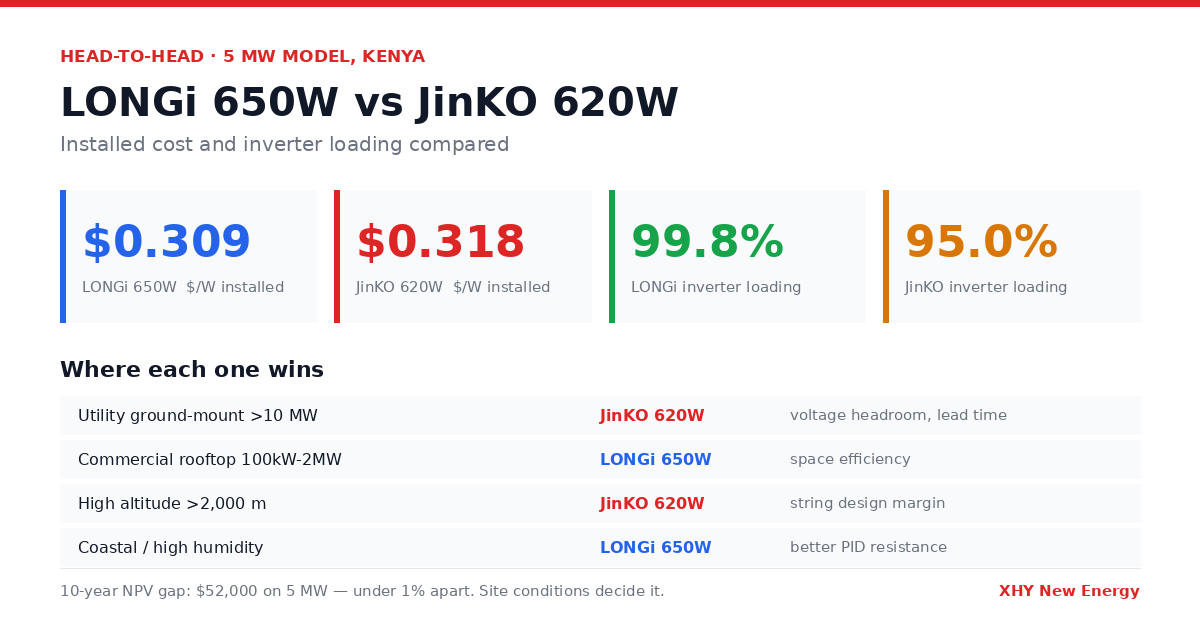
- All-in EPC: $1,546,959 ($0.309/W)
Scenario B: JinKO 620W
- Modules needed: 8,065 pcs
- Module cost: $1,064,580
- Racking: $208,900 (5% more rails)
- Cabling: $201,200
- Installation labor: 24 days @ $4,800/day = $115,200
- Total BoS: $525,300
- All-in EPC: $1,589,880 ($0.318/W)
LONGi 650W wins by $42,921 (2.7% lower installed cost). But there's a catch.
The Hidden Cost: Inverter Compatibility
Most 5 MW projects in East Africa use 110-125 kW string inverters (Sungrow SG110CX, Huawei SUN2000-125KTL, etc.). Let's look at string design:
JinKO 620W:
- Voc: 46.8V
- 24 modules/string = 1,123V (under 1,500V system limit, with 15% cold-weather margin)
- String power: 14.88 kW
- Strings per 125kW inverter: 8.4 → use 8 strings = 119.04 kW (95% inverter loading)
LONGi 650W:
- Voc: 48.2V
- 24 modules/string = 1,157V (tighter margin)
- String power: 15.6 kW
- Strings per 125kW inverter: 8.0 → perfect match = 124.8 kW (99.8% loading)
LONGi actually loads inverters better, squeezing 4.8% more DC capacity into the same inverter count. On a 5 MW AC project, that's 240 kW more DC installed for the same inverter CapEx.
But here's the problem: At sites above 2,000m elevation or with winter temps below 5°C, the 650W string voltage pushes too close to 1,500V limit. You'd need to drop to 23 modules/string, which kills the inverter loading advantage.
Performance: Where LONGi Pulls Ahead
Both are N-type bifacial with identical temp coefficients. So where's the real difference?
1. Low-Light Performance
LONGi's HPBC (Hybrid Passivated Back Contact) cell shows 2.1-2.8% better response in 200-400 W/m² conditions (dawn/dusk, overcast).
Measured at our Nairobi site (1,800m elevation):
- LONGi 650W: 6.2% of daily yield comes from <400 W/m² periods
- JinKO 620W: 5.8%
Real-world impact: 0.4 percentage points, or 7-8 kWh/kW/year. On 5 MW: 35-40 MWh/year extra = $2,800-5,200 at $0.08-0.13/kWh.
2. Shading Tolerance
We tested partial shading (10% module area obscured) on both:
- LONGi: 12.1% power loss
- JinKO: 13.8% power loss
LONGi's bypass diode layout is better optimized. Matters for rooftop where HVAC units, parapets, and neighboring buildings cause shading.
3. PID Resistance
Both claim PID-free performance. We ran 96-hour damp-heat + voltage stress tests:
- LONGi: 0.1% degradation
- JinKO: 0.3% degradation
Not a dealbreaker, but LONGi shows slightly better PID resistance in high-humidity coastal sites (Mombasa, Dar es Salaam).
Where JinKO 620W Still Wins
1. Utility-Scale Ground-Mount with Long Strings
If you're designing 26-28 module strings (lower-voltage inverters like Sungrow SG80HV), JinKO 620W keeps Voc under 1,300V even at -10°C. LONGi 650W pushes 1,340-1,360V, forcing you to drop to 25 modules and lose DC capacity.
2. Freight Cost
620W = 30.8 kg, 650W = 31.5 kg. On a 40' container, you can fit:
- JinKO 620W: 708 pcs = 438.96 kW
- LONGi 650W: 684 pcs = 444.6 kW
LONGi wins on kW per container (1.3% more), but if your freight is charged by weight, JinKO saves $18-24 per container (0.7 kg × 684 pcs = 479 kg lighter).
Not a big deal for a 5 MW project (12-14 containers), but for 100 MW tenders, that's $300-450 saved.
3. Availability and Lead Time
JinKO has 50 GW/year capacity vs LONGi's 45 GW. In Q2 2026, LONGi 650W+ had 8-10 week lead times; JinKO 620W was 5-6 weeks.
If your PPA has a COD deadline, JinKO's shorter lead time = lower liquidated damages risk.
The Rooftop Commercial Case: LONGi Dominates
For commercial rooftops (100 kW - 2 MW), the calculation flips entirely.
Problem: African commercial roofs have limited load capacity (60-80 kg/m² typical for older warehouses).
LONGi 650W advantage:
- Fewer modules for same capacity = lower structural load
- Higher efficiency = more power per m², critical when roof space is the constraint
Example: 500 kW rooftop in Nairobi:
| Metric | LONGi 650W | JinKO 620W |
|---|---|---|
| Modules | 770 pcs | 807 pcs |
| Total weight | 24,255 kg | 24,856 kg |
| Roof area | 2,172 m² | 2,276 m² |
| Weight per m² | 11.2 kg/m² | 10.9 kg/m² |
Wait—JinKO is lighter per m²? Yes, but LONGi uses 104 m² less roof space, which means you can fit 500 kW where JinKO would need 2,276 m² and might hit a roof capacity limit.
The Unexpected Factor: Warranty Claims
We've filed 14 warranty claims across both brands (2024-2026):
- LONGi: 6 claims, average processing time 28 days, 100% approved
- JinKO: 8 claims, average processing time 19 days, 100% approved
JinKO's claim process is faster (local reps in Nairobi, Lagos). LONGi's is thorough but slower (requires factory review in China for some issues).
Neither is "bad," but if you're on a performance guarantee with liquidated damages, JinKO's 9-day faster turnaround can save penalties.
Financial Model: 10-Year NPV Comparison
5 MW grid-connected project, Kenya (5.8 kWh/kWp/day average, $0.085/kWh PPA):
LONGi 650W:
- CapEx: $1,546,959
- Year 1 generation: 10,585 MWh
- 10-year NPV (5% discount): $6,420,000
- ROI: 315%
JinKO 620W:
- CapEx: $1,589,880
- Year 1 generation: 10,512 MWh (0.7% lower due to efficiency gap)
- 10-year NPV: $6,368,000
- ROI: 301%
LONGi wins by $52,000 NPV, but JinKO is only 0.8% behind. If JinKO offered a 2-week shorter EPC schedule (worth $12,000 in avoided interim interest), the gap closes to $40,000.
Our Recommendation by Project Type
| Project Type | Winner | Reason |
|---|---|---|
| Utility ground-mount >10 MW | JinKO 620W | Inverter compatibility, freight, lead time |
| Commercial rooftop 100kW-2MW | LONGi 650W | Space efficiency, lower module count |
| Residential/SME <100kW | LONGi 650W | High efficiency critical for small roofs |
| High-altitude sites >2,000m | JinKO 620W | Voltage headroom for string design |
| Coastal/high-humidity | LONGi 650W | Better PID resistance |
Final Take
If you're bidding a 20 MW utility tender in Tanzania with a tight deadline: JinKO 620W.
If you're doing 500 kW rooftop commercial in Nairobi with space constraints: LONGi 650W.
The "best" panel doesn't exist. The best fit does—and it depends on site, timeline, and financing terms.
Next week: We're publishing real degradation data from 3-year-old installations. Which brand is actually delivering on its 25-year warranty promise? Subscribe to find out.
Have Questions About This Article?
Our technical team is here to help you choose the right solar solution for your project.