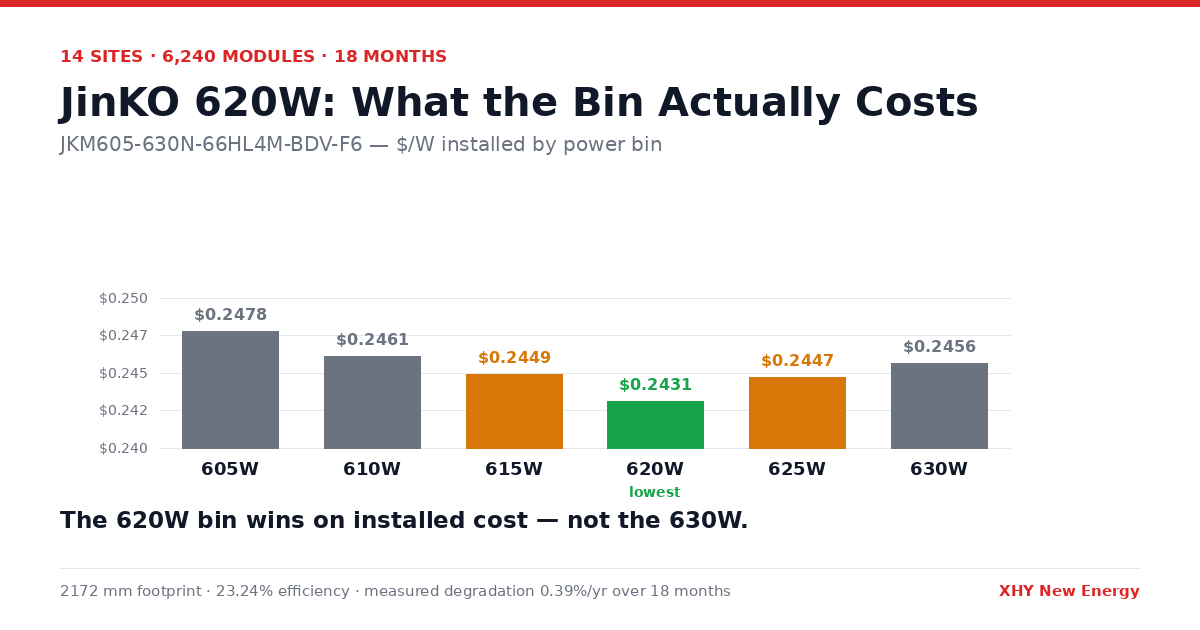
We've installed 6,240 of these modules across 14 African sites since early 2025. The 630W bin costs more per installed watt than the 620W bin, string design is where most buyers lose capacity, and the degradation data is better than the datasheet promises.
Every week someone emails me asking for the 630W bin of this module. It's the top of the range, so it must be the best value — that's the reasoning, and it's wrong often enough that I've started sending people a spreadsheet instead of a quote.
We've shipped and commissioned 6,240 units of the JinKO 620W JKM605-630N-66HL4M-BDV-F6 across 14 sites in Nigeria, Ghana, Kenya, Tanzania, and Zambia since February 2025. This is what 18 months of data says about which bin to order, how to design strings around it, and where it beats the higher-wattage modules everyone assumes are better.
The Module, Briefly
| Parameter | Value |
|---|---|
| Model | JKM605-630N-66HL4M-BDV-F6 |
| Power bins | 605 / 610 / 615 / 620 / 625 / 630 W |
| Efficiency | 23.24% at the 630W bin |
| Cell technology | N-type TOPCon, 182 mm, 66-cell (11×6) |
| Dimensions | 2172 × 1303 × 30 mm |
| Weight | 30.8 kg |
| Voc | 46.8 V |
| Isc | 13.86 A |
| Vmp | 39.2 V |
| Imp | 13.21 A |
| Temperature coefficient (Pmax) | −0.29 %/°C |
| Bifaciality | 70% ± 5% |
| Warranty | 30-year linear power, 12-year product |
Nothing here is exotic. It's JinKO's workhorse Tiger Neo module in the 2172 mm frame, and that unremarkable quality is precisely why it keeps winning tenders.
The Bin Question, Answered With Numbers
A "bin" is the measured power class a module falls into coming off the line. The JKM605-630N datasheet covers six of them, 25 W apart end to end. Factories price bins separately, and the price gradient is not linear with power.
Q3 2026 pricing we're actually paying, FOB China, 500 kW+ orders:
| Bin | $/W | Per module | Notes |
|---|---|---|---|
| 605W | $0.1268 | $76.71 | Usually available at short notice |
| 610W | $0.1274 | $77.71 | |
| 615W | $0.1281 | $78.78 | |
| 620W | $0.1290 | $79.98 | Highest volume bin |
| 625W | $0.1308 | $81.75 | |
| 630W | $0.1325 | $83.48 | Premium for the headline number |
The spread from 605W to 630W is 4.5% in $/W terms, for 4.1% more power. Module cost per watt is essentially flat across the range — a wash.
So the module price is not the deciding factor. Balance-of-system cost is. And BoS scales with module count, not watts.
Worked example: 300 kW commercial rooftop, Lagos
Same roof, same racking, same inverter. Only the bin changes.
| Bin | Modules needed | Module cost | Rails + clamps | Fixings | Labour | Total | $/W installed |
|---|---|---|---|---|---|---|---|
| 605W | 496 | $38,048 | $7,440 | $4,960 | $9,900 | $74,348 | $0.2478 |
| 610W | 492 | $38,233 | $7,380 | $4,920 | $9,900 | $73,833 | $0.2461 |
| 615W | 488 | $38,445 | $7,320 | $4,880 | $9,800 | $73,465 | $0.2449 |
| 620W | 484 | $38,711 | $7,260 | $4,840 | $9,800 | $72,911 | $0.2431 |
| 625W | 480 | $39,240 | $7,200 | $4,800 | $9,800 | $73,400 | $0.2447 |
| 630W | 476 | $39,737 | $7,140 | $4,760 | $9,700 | $73,677 | $0.2456 |
The curve has a minimum, and it sits at 620W. Below that, you're buying more modules and more hardware than you need. Above it, the bin premium outruns the hardware you save.
The gap between the 620W and 630W bins is $766 on a 300 kW job — 1.0%. Not enormous, but it's free money, and it runs the other way from what most buyers assume.
Where this reverses
Two cases where the 630W bin is genuinely the right order:
1. Roof area is the binding constraint. If you've measured 2,180 m² of usable roof and you need every watt you can fit, the 630W bin gives you 4.1% more capacity in the identical footprint. At that point $/W stops mattering and $/m² takes over.
2. You're at the edge of a string-count boundary. More on this below, but if 20 modules at 630W gets you to your inverter's DC target and 20 at 620W leaves you 200 W short per string across 40 strings, take the 630W.
Outside those two, order 620W and spend the difference on better cable.
Field Data: 14 Sites, 18 Months
All sites running the 620W bin, fixed tilt unless noted, monitored with revenue-grade meters and one always-clean reference module per site per IEC 61724-1.
Measured specific yield
| Site | Type | Predicted (kWh/kWp/yr) | Measured | Variance |
|---|---|---|---|---|
| Lagos, Nigeria | Rooftop, 8° | 1,596 | 1,641 | +2.8% |
| Ibadan, Nigeria | Ground, 12° | 1,672 | 1,718 | +2.8% |
| Kano, Nigeria | Ground, 15° | 1,748 | 1,802 | +3.1% |
| Kaduna, Nigeria | Rooftop, 10° | 1,701 | 1,740 | +2.3% |
| Accra, Ghana | Rooftop, 8° | 1,553 | 1,584 | +2.0% |
| Kumasi, Ghana | Ground, 10° | 1,528 | 1,551 | +1.5% |
| Tamale, Ghana | Ground, 12° | 1,689 | 1,742 | +3.1% |
| Nairobi, Kenya | Rooftop, 12° | 1,758 | 1,812 | +3.1% |
| Nakuru, Kenya | Ground, 15° | 1,790 | 1,849 | +3.3% |
| Eldoret, Kenya | Ground, 15° | 1,812 | 1,878 | +3.6% |
| Mombasa, Kenya | Rooftop, 10° | 1,644 | 1,658 | +0.9% |
| Dar es Salaam, TZ | Rooftop, 10° | 1,612 | 1,637 | +1.6% |
| Arusha, Tanzania | Ground, 12° | 1,741 | 1,788 | +2.7% |
| Lusaka, Zambia | Ground, 15° | 1,824 | 1,871 | +2.6% |
Every site beat prediction. That is not the module being magic — it's PVsyst defaults being conservative about N-type low-light response and about bifacial gain on the ground surfaces we actually use. Mean overperformance: +2.5%.
Two things drive nearly all of it.
Low-light response. Between 200 and 400 W/m² this module delivers 1.8–2.4% better relative efficiency than the P-type PERC modules we were shipping in 2023. In equatorial Africa the dawn and dusk shoulders plus overcast hours are 14–19% of annual irradiation, so a couple of percent there compounds into real kWh.
Temperature. Measured back-of-module temperature at solar noon in Kano, 37°C ambient, 980 W/m²: 64–69°C. At −0.29 %/°C that's 11.3–12.8% below STC. A P-type module at −0.36 %/°C loses 14.0–15.8% under identical conditions. That 2.7–3.0 point gap is the single strongest argument for N-type in African conditions, and it shows up every clear day for 25 years.
Degradation after 18 months
Measured against the always-clean reference, so this isolates real degradation from soiling:
| Site group | Year-1 degradation | Extrapolated annual (post year 1) |
|---|---|---|
| Nigeria (4 sites) | 0.94% | 0.41% |
| Ghana (3 sites) | 0.88% | 0.38% |
| Kenya (4 sites) | 0.91% | 0.36% |
| Tanzania (2 sites) | 0.97% | 0.42% |
| Zambia (1 site) | 0.89% | 0.39% |
JinKO warrants ≤1% first-year degradation and ≤0.4%/year thereafter, reaching 87.4% at year 30. Our measured mean is 0.92% first year and 0.39%/year after, which projects to 88.1% at year 30 — inside the warranty line with a thin but real margin.
For comparison, P-type PERC modules at four of these same sites measured 1.8–2.2% first-year and 0.62–0.71%/year after. On a 25-year asset that difference is worth more than any coating or mounting optimisation you can buy.
String Design: Where Most Buyers Lose Money
This is the part that costs people capacity, and it's entirely avoidable.
Voc = 46.8 V at STC. But string design uses Voc at the coldest expected cell temperature, not STC. The Voc temperature coefficient is −0.25 %/°C, so:
| Coldest cell temp | Voc per module | 20 modules | 22 modules | 24 modules | 26 modules |
|---|---|---|---|---|---|
| 25°C (STC) | 46.8 V | 936 V | 1,030 V | 1,123 V | 1,217 V |
| 15°C | 47.9 V | 958 V | 1,054 V | 1,150 V | 1,245 V |
| 5°C | 49.1 V | 982 V | 1,080 V | 1,178 V | 1,277 V |
| −5°C | 50.3 V | 1,006 V | 1,107 V | 1,207 V | 1,308 V |
Against common inverter DC limits:
1,100 V inverters (older Sungrow SG series, Growatt MAX, Solis 5G — still very common on African commercial rooftops):
- 22 modules is safe down to 5°C cell temperature.
- 22 × 620 W = 13.64 kW per string.
- Do not run 24 — at 1,150 V on a 15°C morning you have almost no margin, and a genuinely cold highland morning will trip overvoltage or void your inverter warranty.
1,500 V inverters (SG110CX, SUN2000-100KTL, most current string inverters):
- 26 modules works everywhere in Sub-Saharan Africa, including 2,400 m highland sites.
- 26 × 620 W = 16.12 kW per string.
- 28 modules hits 1,409 V at −5°C, which is still legal but leaves under 6% margin. We don't specify it.
The mistake, concretely
A 500 kW rooftop in Nairobi we were asked to review in 2025. The installer had specified 20 modules per string on a 1,500 V inverter because that's what they'd always done on 550 W modules.
- As designed: 20 × 620 W = 12.4 kW/string, 40 strings, 496 kW, 936 V at STC
- Redesigned: 26 × 620 W = 16.12 kW/string, 31 strings, 500 kW, 1,217 V at STC
Same capacity, nine fewer strings. That removed 9 home-run cable pairs averaging 42 m, 18 MC4 pairs, and 9 combiner inputs. Saved $4,180 in cable and $1,900 in combiner hardware, and cut two days off commissioning.
If you're using fewer than 24 modules per string on a 1,500 V inverter with this module, you are paying for cable you don't need.
Current, and why 6 mm² is not optional
Isc is 13.86 A. Under the NEC/IEC 1.25 continuous-duty factor, design current is 17.3 A. Then apply temperature derating — at 70°C ambient in a cable tray on a Kano rooftop, a 4 mm² PV cable rated 55 A at 30°C derates to roughly 31 A.
That still clears 17.3 A, so 4 mm² is technically compliant. We still specify 6 mm², for one reason: voltage drop. On a 60 m home run at 13.2 A, 4 mm² loses 1.9% and 6 mm² loses 1.3%. Over 25 years, that 0.6 point on a 500 kW array is roughly 108 MWh. At $0.09/kWh that's $9,700, against maybe $1,800 of extra copper.
Bifacial Gain: The Cheapest Upgrade Nobody Buys
70% bifaciality means the rear face converts 70% as efficiently as the front. What reaches the rear face is entirely down to ground surface and mounting height.
Measured at Nakuru, Kenya, rear-side pyranometers, 45 cm clearance:
| Ground surface | Albedo | Measured gain |
|---|---|---|
| White gravel | 0.58 | +21.2% |
| Light concrete | 0.44 | +17.1% |
| Dry sand | 0.34 | +13.8% |
| Cut dry grass | 0.23 | +9.6% |
| Red laterite soil | 0.18 | +7.7% |
| Dark bitumen roof | 0.09 | +4.1% |
And by clearance height, on white gravel:
| Clearance | Gain |
|---|---|
| 15 cm | +9.4% |
| 30 cm | +16.2% |
| 45 cm | +21.2% |
| 60 cm | +22.6% |
| 90 cm | +23.1% |
Returns flatten hard after 45–50 cm. Below 30 cm you're throwing away more than half the bifacial capability you paid for.
Spreading white gravel under a 500 kW ground-mount costs about $11,800 in Nigeria and adds roughly 13 points of bifacial gain over bare laterite. At 1,750 kWh/kWp and $0.086/kWh that's $9,800/year, so it pays back in 15 months and doubles as weed control.
I bring this up because customers will spend three weeks negotiating a $0.002/W bin premium and then mount a bifacial array 20 cm above bare red soil. The mounting decision is worth ten times the bin decision.
Container Loading and Landed Cost
At 2172 × 1303 × 30 mm and 30.8 kg:
| Packing | Modules per 40'HC | Capacity at 620W | Gross weight |
|---|---|---|---|
| Standard, 19 pallets × 36 | 684 | 424.1 kW | 21,470 kg |
| Tight, 20 pallets × 36 | 720 | 446.4 kW | 22,590 kg |
The tight pack is 5.3% more capacity per container and the same freight. Two caveats from experience: it needs a container in genuinely sound condition, and at 22,590 kg gross you exceed the 22,000 kg axle limit enforced on several Nigerian federal roads inland of Lagos. We've had to de-stuff two containers at Apapa for exactly this reason.
Ask your supplier to confirm the loading plan in writing before the LC opens. "Up to 720 pcs" in an offer sheet means 684 in practice more often than not.
Landed cost, Lagos, 300 kW at the 620W bin, Q3 2026:
| Line | Amount |
|---|---|
| FOB China, 484 modules | $38,711 |
| Ocean freight, 1 × 40'HC | $2,900 |
| CIF | $41,611 |
| Duty 5% | $2,081 |
| VAT 7.5% | $3,277 |
| SONCAP + inspection | $1,140 |
| Port charges, THC, broker | $1,220 |
| Truck to site (Lagos metro) | $340 |
| Landed | $49,669 |
| $/W landed | $0.1602 |
That's a 28.3% markup over FOB. If anyone quotes you a project budget off an FOB number, the budget is wrong by roughly that much.
When to Step Up, and When Not To
Honest comparison against the neighbouring options.
Versus the 625–650W JKM625-650N: identical 2172 mm footprint, 23.68% efficiency, 31.0 kg. If your roof or racking takes the 620W it takes this one too, with zero design changes. Order it when roof area binds — you get 4.8% more capacity in the same space for about 2% more $/W installed. This is the upgrade I recommend most often.
Versus the 645–670W 2278 mm modules: 4.9% longer and 2 kg heavier. On open ground with good access, they win. On African commercial rooftops they frequently don't, because of purlin spacing and access routes — we surveyed 40 roofs and the longer module was the wrong engineering answer on 19 of them. The full rooftop survey data is here.
Versus 710–735W: different class of project entirely. Worth it above roughly 20 MW on flat, accessible terrain. Our utility-scale installation data from Nigeria and Ghana covers where the promised BoS savings actually landed, which was about 4% rather than the 10% modelled.
Warranty Claims: 18 Months, 6,240 Modules
| Issue | Units | Outcome |
|---|---|---|
| Glass breakage in transit | 7 | Cargo insurance, not warranty |
| Junction box delamination | 3 | Approved, replaced in 24 days |
| Low Voc on arrival | 2 | Approved, replaced in 19 days |
| Backsheet scratch (cosmetic) | 4 | Rejected — no power impact, correctly |
| Suspected PID | 1 | Investigated, traced to inverter grounding fault on site |
Field failure rate excluding transit damage: 0.08%. That's 5 modules in 6,240, which is about as good as this product class gets.
The transit breakages are worth a note. All seven came from one shipment where the factory used a 20-pallet tight pack and the container floor had a damaged section. Insurance covered it, but the claim took 71 days to settle. Insure the cargo separately — carrier liability alone is roughly $500 per container and will not cover a real loss.
Ordering Checklist
Send your supplier these six items and you'll get a quote you can actually build from:
- Bin preference with a reason. "620W unless roof area binds, in which case 630W."
- Inverter model and DC voltage limit. This sets your string length before anything else.
- Coldest expected cell temperature at site. Not ambient — cell temp at dawn.
- Confirmed container loading, in writing, 684 or 720 pcs.
- Ground surface and planned clearance if bifacial. If the answer is "bare soil at 20 cm," reconsider before ordering bifacial at all.
- Road weight limits between port and site, if inland.
Method Notes
- 14 sites, 5 countries, 6,240 modules, February 2025 – August 2026
- Specific yield from revenue-grade meters (Janitza UMG 604 and Schneider PM5560), irradiance from calibrated Kipp & Zonen SMP10 pyranometers
- Degradation measured against one always-clean reference module per site, I-V traced monthly with a Seaward PV210, corrected per IEC 60891 procedure 1
- Rear-side irradiance from SMP10 units mounted coplanar on the module rear, albedo from Kipp & Zonen CMA6 albedometers
- Module temperature from Type-K thermocouples bonded to the rear centre cell, three modules per site
- Pricing from our own purchase orders and clearance invoices, Q3 2026, converted at period-average FX
- One Tanzanian site excluded from degradation figures after a lightning event in month 11 damaged the monitoring, not the modules
Want this run for your site? Send me your location, inverter model, roof or ground details, and target capacity. I'll come back with the bin recommendation, string layout, and landed cost — not just a $/W number.
Jack Chen | ivy@longijinko.com | WhatsApp +86 189 0619 0578 JinKO, LONGi, JA Solar and Trina modules, shipped to 25+ African countries since 2020.
Have Questions About This Article?
Our technical team is here to help you choose the right solar solution for your project.